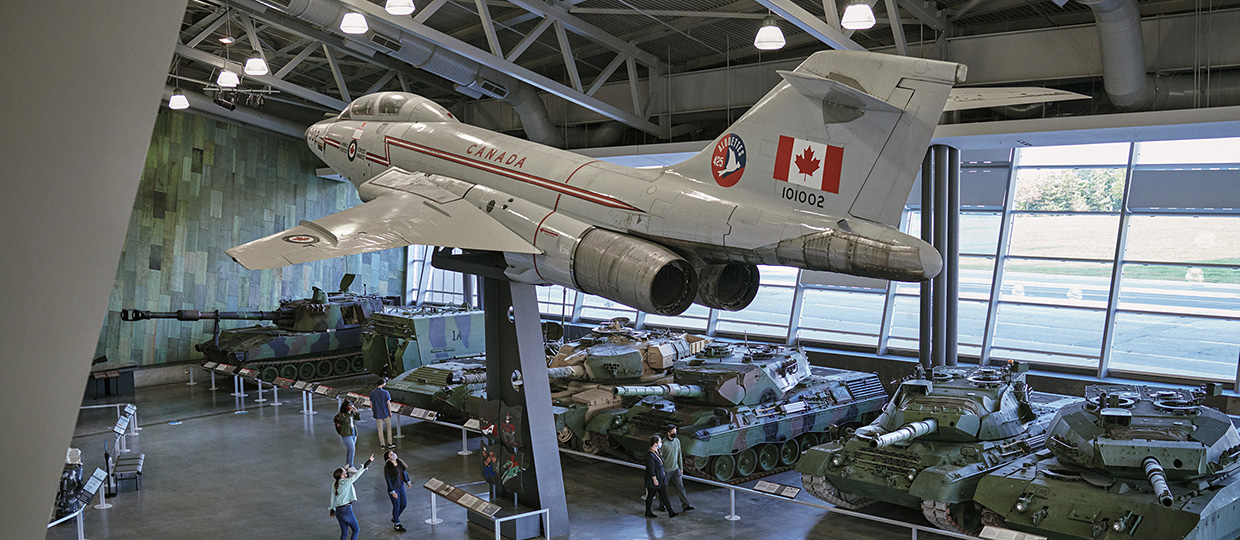
Each year, millions do. Since 1989, more than twenty-one million
people have visited the Museum; and since 1994, millions more have
examined our award-winning Web site from computers across the country
and around the world. Beyond that, thousands of people read our books or
receive personal responses to their questions by phone, letter or email.
Thus, it is fair to say that the Museum has become a cultural institution
of national and international repute.
But how did the Museum come to this position? Many people know that
the Canadian Museum of Civilization is a transformation of the old
National Museum of Man, which, from the 1960s to the 1980s, was part of
the old National Museums of Canada Corporation. Some also know that the
history goes back further than that. We have been fortunate in being able
to explore these roots in some detail.

The Geological Survey of Canada and its museum, from 1852 to 1881
76, Saint-Gabriel Street, Montreal.
CMC Archives 69409 LS |
|  |
Ian Dyck came to this project as a curator with an interest in the
history of Canadian archaeology. Since the history of archaeology
includes the early work of the Geological Survey of Canada and its
museum, Dyck’s studies generated insights into the development of
anthropology in the National Museum of Canada. Encouraged by Museum
directors, Dyck enlarged his studies into a general outline of human
history in the National Museum, showing that its origins lay in the
1856 Geological Survey of Canada Act. That Act gave the Survey a mandate
to establish a Provincial Museum (Canada was then a province of the British
Empire), which eventually developed into the National Museum of Canada,
and then split into several museums including the Canadian Museum of
Civilization.
Brigitte Lafond, a librarian, has taken a long-term interest in
developing the CMC’s holdings of published records bearing on the history
of the institution. Due to the fact that the Museum Library has several
times been divided amongst institutions, the relevant records are now
somewhat dispersed. Lafond’s attempts to fill the gaps by acquiring
copies of old publications have piqued her interest in the subject. On
numerous occasions she and Dyck have facilitated each other’s work — both
in searching the history of the Museum and in finding records that have
added to the Library’s holdings. Consequently, their co-curatorship of
this exhibition has been a natural extension of common interests.
The exhibition work has given us a number of satisfying insights. For
one thing, we now know why the Geological Survey got involved in human
history studies. Part of the answer lies in the objectives established
for the Survey’s museum by Sir William Logan. Almost from the beginning,
he was determined that the museum would illustrate not only the science
of geology, but also the uses to which Canada’s geological resources
could be put. That meant human uses, which required an understanding
of a wide range of human activities. A related factor was that the
Geological Survey did much general scientific exploration, which gave
its staff unusual opportunities to make observations on human activities
across the country, particularly beyond urban settings. The geologists
were fascinated by what they saw and, knowing that traditional lifestyles
were changing in the face of industrial development, felt obliged to make
a record of what they saw before it disappeared.
Feelings of personal obligation that went beyond regular job
requirements were characteristic of many Geological Survey of Canada
geologists. The initiative they showed in discharging complex tasks at
high levels of performance under difficult circumstances became a
tradition. It is hard to imagine, for example, how far Robert Bell
travelled into the wilderness, and how many anthropological observations
and collections he made as a sideline to a rigorous daily regime of
geology. That tradition was adopted by National Museum staff and accounts
for much their accomplishment, even through periods of war and economic
crisis. The work of predecessors such as George Dawson, Edward Sapir,
Marius Barbeau, Diamond Jenness, Harlan Smith, Mabel Godwin and many
others remains an inspiration today.
One thing that is especially clear to us now is that we should be
cautious in assessing the breadth, quality and innovativeness of our
own work. Much that we might claim to be new or better than anything
the Museum has done before, often turns out to have been tried, with
considerable success, in the past. The present Canadian Museum of
Civilization is indeed grander than its predecessors, but this is at
least partly because its foundations are deep, solid and very complex.
Brigitte Lafond is Head of the CMC Library. Ian Dyck is the CMC
Curator of Plains Archaeology and co-author of the book,
A World Inside: A 150-Year History of the Canadian Museum of Civilization
(
Un monde en soi : 150 ans d’histoire du Musée canadien des civilisations).
|