Introduction
Canada played a major role during the First and Second World Wars, with close to two million men and women serving in uniform at home and abroad. This involvement came with a price: More than 110,000 lost their lives during the wars and in the immediate aftermaths.
Throughout the First World War, more than 650,000 men and women served in uniform as part of the Canadian Expeditionary Force (CEF), the Canadian Corps being its fighting arm. By 1916, the Corps consisted of four divisions fighting on the Western Front in France and Belgium. More than 22,000 Canadians were also keen on joining the air war and served with the British flying services: the Royal Flying Corps and the Royal Naval Air Service, which were unified as the Royal Air Force in April 1918. An estimated 1,600 Canadian airmen died either in action during the war, or from accidents or illness. About 9,000 Canadians served with the Royal Canadian Navy and the Royal Naval Canadian Volunteer Reserve, with close to 400 losing their lives.
Newfoundland was a separate Dominion. During the First World War, more than 6,000 Newfoundlanders served in the Royal Newfoundland Regiment, Newfoundland Forestry Companies, the Royal Navy, and the Merchant Marine. More than 1,800 individuals died during or as a result of the war, including those who served with the CEF, the British Army, and the Royal Navy.
Canada entered the Second World War on September 10, 1939. Over the course of the next six years, more than one million men and women volunteered with the Canadian Army, the Royal Canadian Air Force, the Royal Canadian Navy, and the Merchant Navy. At one point or other during the war, more than 12,000 Newfoundlanders — still part of a separate Dominion — served at home or abroad, largely in various branches of the British military, or in the Merchant Navy.
By the end of 1947, more than 47,000 Canadians and Newfoundlanders had died during the war or of its effects.
Researching Canada’s war dead can be an act of commemoration and remembrance, with a wide range of resources available. The first group of records described in this document encompasses both world wars. The second and third groups relate separately to each war, representing individuals who served in Canadian and Newfoundland forces, but not necessarily to Canadians and Newfoundlanders who served in Commonwealth or other foreign forces.
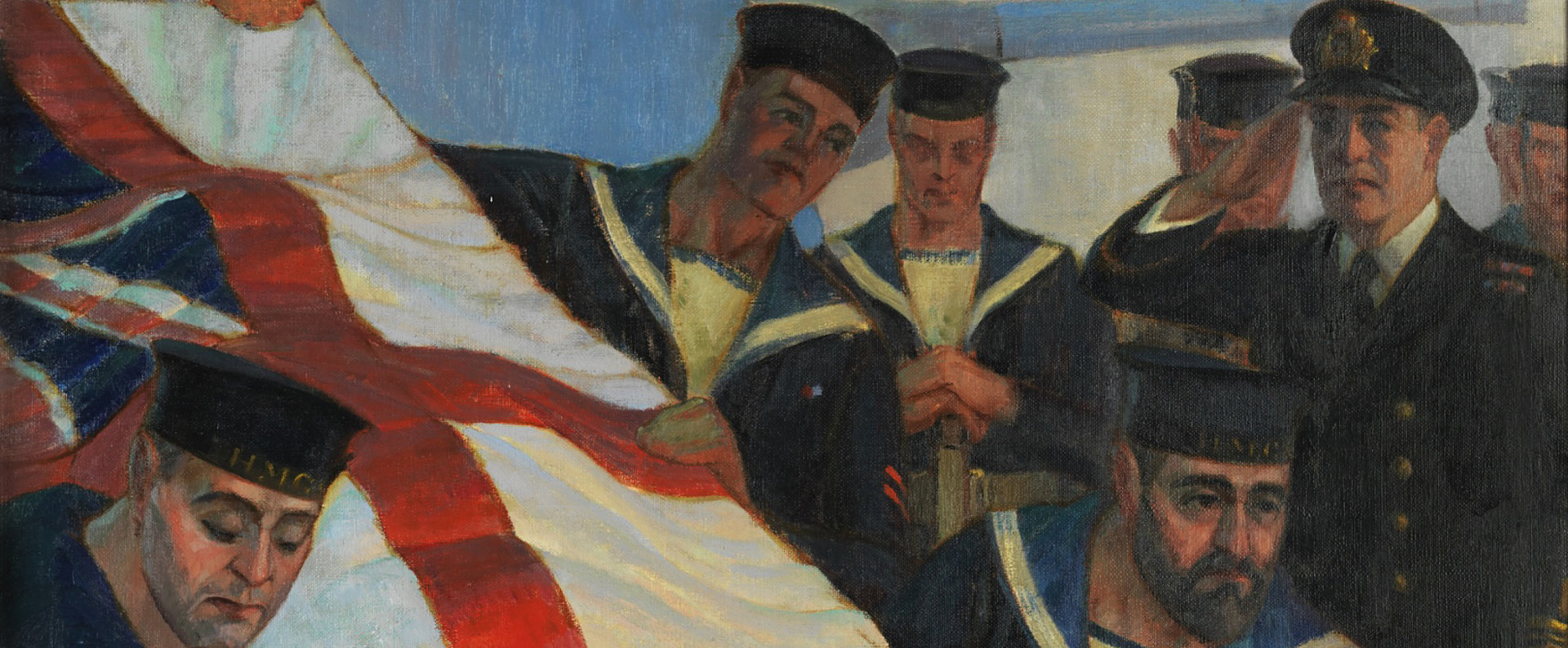
Image at top of page:
Thomas Harold Beament
Burial at Sea
Beaverbrook Collection of War Art
Canadian War Museum
CWM 19710261-0993
Records Relating to Both World Wars
Canadian Virtual War Memorial
Research on an individual who died while serving during the First or Second World War begins with the Canadian Virtual War Memorial (CVWM) on the Veterans Affairs Canada website. The information on this site is drawn from the work of the Commonwealth War Graves Commission (CWGC) and other sources. The CWGC documents the dead and the missing of the First World War from August 4, 1914 to August 31, 1921, and the Second World War from September 3, 1939 to December 31, 1947.
The CVWM can be searched by name or keywords. Results may vary from one individual to another and from one war to another, but generally include name, age, and a summary of military service — including regimental number, unit, squadron or ship, date of death, and name and address of next-of-kin. The results may include date and place of birth and enlistment. In all cases, the name, location and description of the cemetery or memorial where the individual is buried or commemorated is included.
The CVWM is a “living” memorial, and many of the entries include a personal digital collection comprised of photographs, newspaper clippings, letters, documents from service files, and other sources that have been added by family or interested researchers.
Canadian Books of Remembrance for the First and Second World Wars, and separate Books of Remembrance for Newfoundland and the Merchant Navy, can be also searched and viewed at the CVWM, along with Books of Remembrance for other conflicts and peacetime service.
Commonwealth War Graves Commission
The CWGC was established as the Imperial War Graves Commission during the First World War to document British Empire (now Commonwealth) war dead, including Canadians and Newfoundlanders. The Commission was responsible for creating and maintaining cemeteries and memorials, and does so to this day. The website includes information on Canadian and Newfoundland dead from both world wars.
For those with identified burials in a cemetery, the results of a search on the CWGC database may include grave reports, an extract from the published cemetery index, and a headstone report with name of the serviceman or woman, unit, date of death, religious emblem (if any), and epitaph with the name of the person who provided the wording. A photograph of the headstone may also be included. For those commemorated on a memorial, the results of a search may include an extract from the published index, and a list with the name of the individual and others appearing on the same memorial panel.
These two websites are the best place to begin any search for information on Canadian and Newfoundland war dead. Additional personal information can be found for both world wars in the records described below.
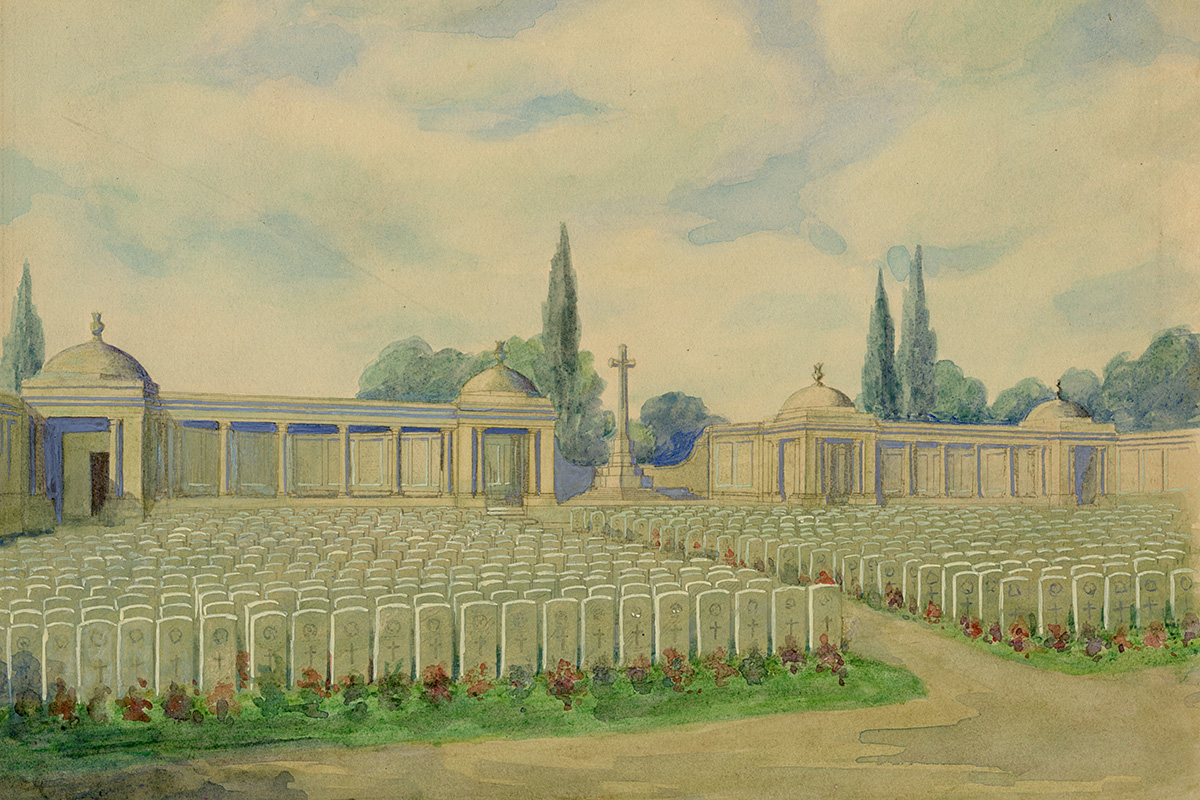
Tyne Cot Cemetary (Passchendaele)
Beaverbrook Collection of War Art
Canadian War Museum
CWM 19710261-1668
Helpful hint
See LAC’s Military Abbreviations used in Service Files page.
Memorials
The Vimy Memorial and the Menin Gate are the primary memorials to Canada’s missing from the First World War. Some airmen are commemorated on the Arras Flying Services Memorial in Arras, France. There is no one single overseas memorial to Canada’s Second World War dead. Members of the RCAF who died overseas with no known grave — more than 3,000 in number — are commemorated on the Runnymede Memorial, Englefield Green, England. Some 800 members of the Royal Canadian Air Force and Commonwealth air forces who died in North America and adjacent waters, and who have no known or accessible grave, are commemorated on the Ottawa Memorial in Ottawa, Ontario.
Most of the sailors, merchant mariners, nursing sisters, and soldiers who died at sea in both world wars are commemorated on the Halifax Memorial in Halifax, Nova Scotia; some are commemorated elsewhere. The Halifax Memorial includes the names of about 3,200 Canadian and Newfoundland sailors, soldiers, and nursing sisters.
The Veterans Affairs Canada website has a database of more than 9,000 memorials in Canada and overseas (Memorials — Remembrance — Veterans Affairs Canada). Those in Canada include monuments, cenotaphs, plaques, honour rolls, cairns, and even memorial hospitals and bridges commemorating the war and those who served and died. Many of these memorials are indexed and can be searched by the names of the individuals they commemorate.
In addition to these national databases and memorials, many communities across Canada have their own memorials to the fallen of the First and Second World Wars. These built memorials can be found in town squares, churches, schools, cemeteries, and other municipal centres. Many communities also have local historical societies, archives, or other organizations that may be useful sources of information when researching a particular individual.
Casualty Identification Program
The Directorate of History and Heritage (DHH) of the Department of National Defence, through the Casualty Identification Program, works to identify newly found skeletal remains and pre-existing unidentified war graves of Canadian service members (including Newfoundlanders before 1949) from the First World War, the Second World War, and the United Nations Operation in Korea (Korean Conflict).
Relatives of soldiers with no known grave from these conflicts can register their details with DHH. This information may help DHH in its investigative process to identify the remains of unknown service members. For more information please see DHH’s site: Casualty Identification Program.
First World War, 1914–1921
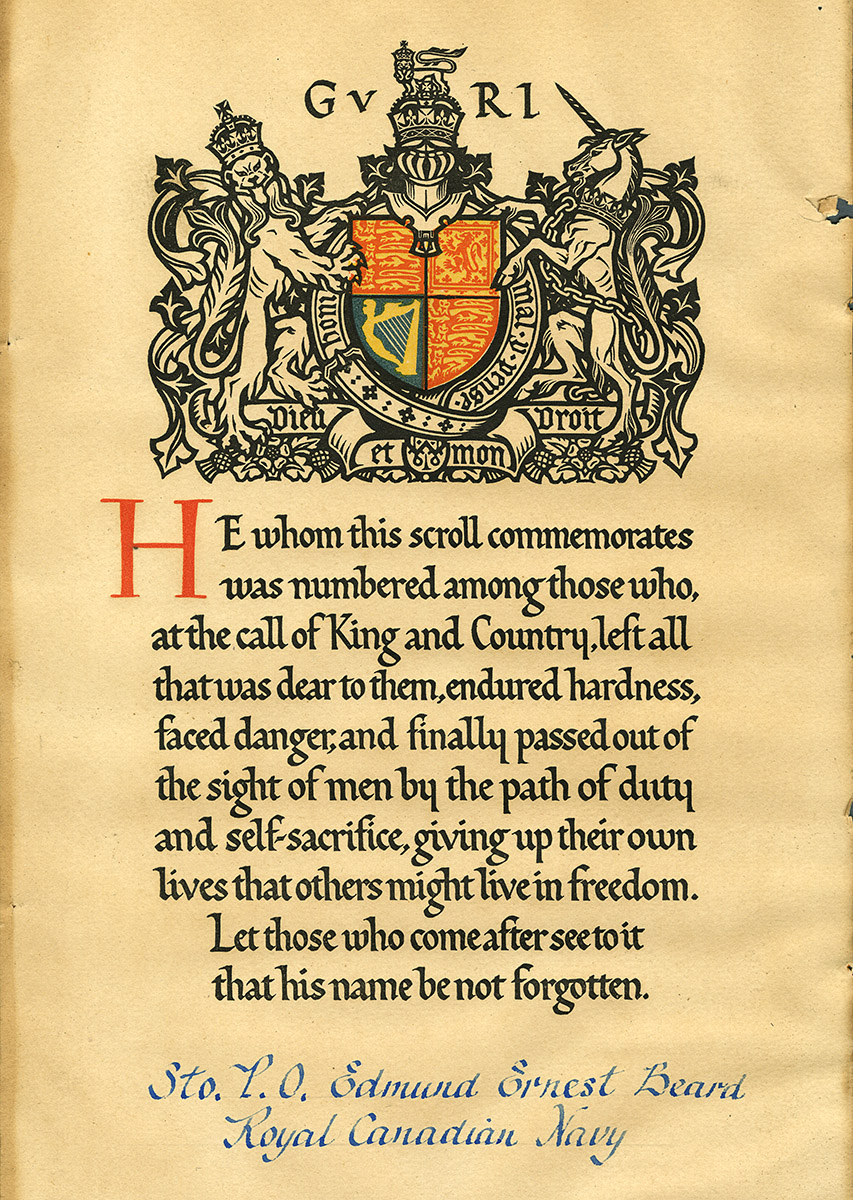
Memorial Scroll for Petty Officer Edmund Ernest Beard
George Metcalf Archival Collection
Canadian War Museum
CWM 20130540-003
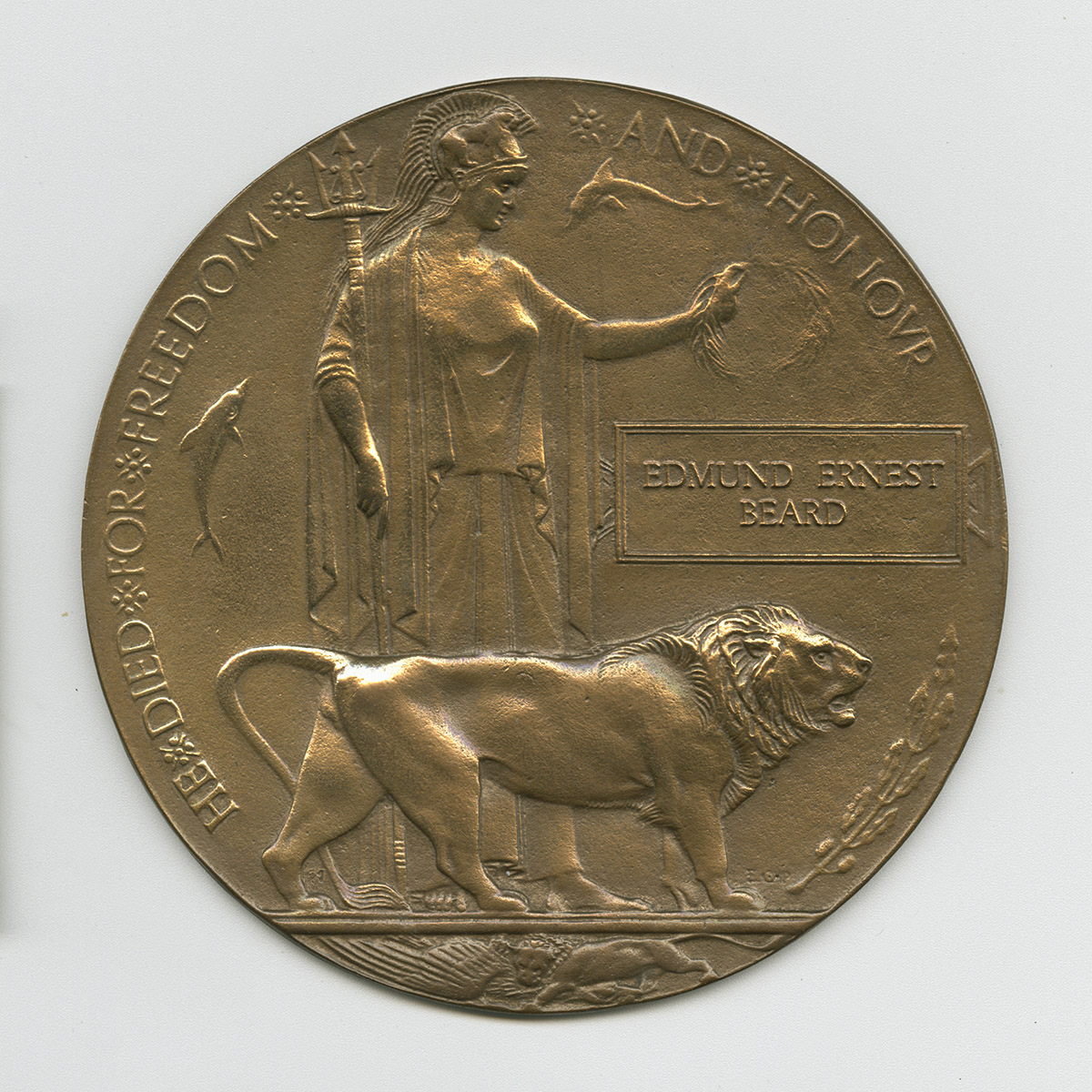
Memorial Plaque for Petty Officer Edmund Ernest Beard
Canadian War Museum
CWM 20130540-002
More than 9 million soldiers and service personnel were killed during the First World War, and countries around the world felt compelled to commemorate these deaths with memorials. In Canada, about 66,000 men and women died during the war, including those who were killed in action; who died of wounds; who died from suicide, accident or drowning; or who died of illness or disease attributable to their service, up to August 31, 1921. Although other Canadians died of their wounds or other service-related causes after this point, this is the official cut-off date for Canada’s First World War dead.
Approximately 18,200 service personnel who were killed in action have no known grave, because their remains could not be located or identified. Most are commemorated on one of two memorials to the missing: the Vimy Memorial and the Menin Gate. Newfoundland’s dead are honoured at the Beaumont Hamel memorial in France.
Construction on Canada’s national memorial at Vimy Ridge — near Arras, France — began in 1925. Designed by architect Walter Allward, the memorial was dedicated in July 1936. It recognizes the significant victory of the Canadian Corps in April 1917, but was erected primarily to commemorate some 11,000 Canadians who died in France, but who have no known grave. Their names are inscribed on the memorial.
The Menin Gate, in Ieper, Belgium, commemorates some 57,000 soldiers of the British Empire, including about 6,940 Canadians, who died during the war in the Ypres Salient — or elsewhere in Belgium — and who have no known grave. Their names and the unit they served with are inscribed on the memorial.
Service Documentation
For more information on a soldier or nurse who died during the war, service documents are available online at Library and Archives Canada (LAC) and on ancestry.ca. Whether the death occurred on a battlefield or in a hospital in England, it has been recorded, but there is often no information about the circumstances of the casualty or the place of burial or commemoration. Next-of-kin received the individual’s medals and, if they were eligible, a Memorial Cross. The recipients are noted in these records. We are fortunate, however, to have two additional sources of information to document First World War dead, which are records initially created by the CWGC and its predecessor agency to record the deaths of those who died during the war.
Newfoundland Died in Service Database
Died in Service is a database on the website of the Provincial Archives of Newfoundland and Labrador, and features the wartime biographies of more than 1,800 individuals who died during the First World War.
It includes those who served with the Royal Newfound Regiment, the CEF, the British Army, the Australian Imperial Force, and the Royal Naval Reserve (Newfoundland and Labrador).
Limits of documentation
Wartime records were created and kept for specific purposes, with contemporary ideas of importance. For example, ethnic origin was not recorded, or a hometown might only be inferred through the address of next of kin, who may only be identified as Mrs. [husband’s name]. In addition, some underage and overage soldiers gave a second name, while some names were misspelled in the administrative process.
Circumstances of Death Registers
The Circumstances of Death Registers provide details, if known, of a soldier or nursing sister’s death. This information was compiled to document the final resting place of service personnel. Each entry is a two-sided form that includes the name of the individual, along with their service number, rank, unit, date of casualty and location, religion, and name and address of next-of-kin. In some cases, the register will include a description of the circumstances of death. This unique information is not necessarily found in service documents.
The reverse of the form may include the name and address of next-of-kin, often dating from the mid-1920s or even later. Upon request, next-of- kin received a copy of the index to the cemetery and, in many cases, a photograph of the gravesite. Unfortunately, the photographs were not attached to the Death Registers. As a result, you might only find a photograph if one was sent with the official card to the family, and subsequently saved by the family.
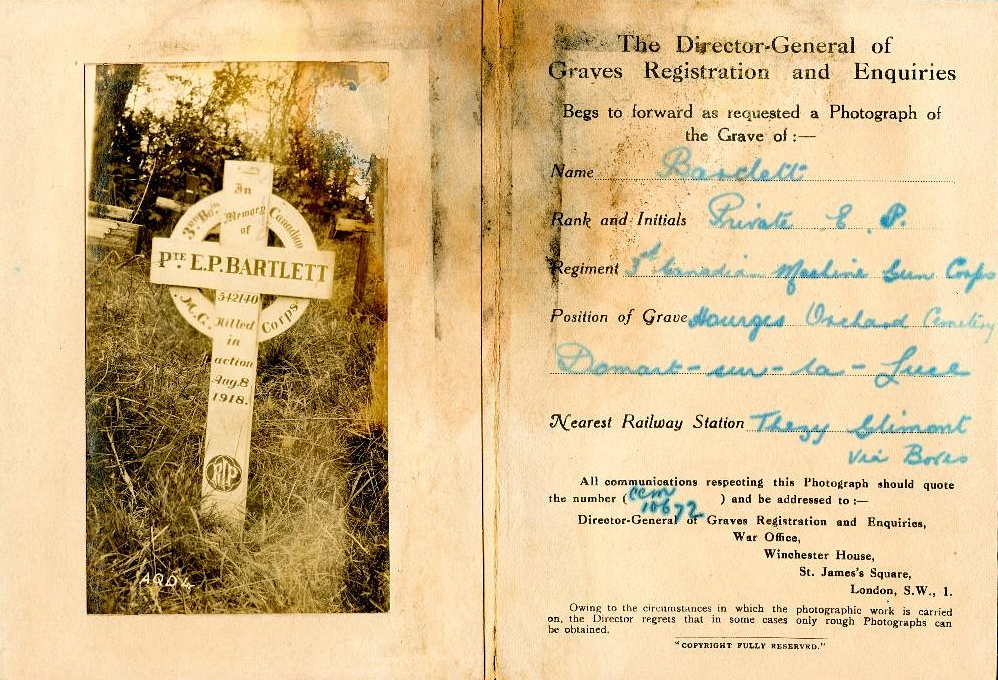
Grave marker photograph card for Private Ernest Percival Bartlett
An example of a grave marker photograph card sent to the next of kin. The details of the individual’s death were transferred to the Death Registers, but the images of the grave were not, and may only survive if kept by the next of kin.
George Metcalf Archival Collection
Canadian War Museum
CWM 20010076-007
There are registers for those who died in France and Belgium, the United Kingdom, Canada, the United States, at sea, and in Siberia, 1918–1919; these records are held by LAC. For those with no known grave in France and Belgium, the forms are stamped with the name of the memorial where the individual is commemorated; for example, the Vimy Memorial or the Menin Gate. Researchers should note that the registers for surnames following “Sims” are missing (LAC: RG 150, accession 1992-93/314, volumes 145–238).
Registers from the United Kingdom document the deaths and burials of about 3,900 Canadians laid to rest in the British Isles (LAC: RG 150, accession 1992-93/314, volumes 138–144). Additional research on every individual who died in the UK during the war is available in Far From Home: A Study of the Great War Canadians (2019) in 102 volumes, available for consultation in the Military History Research Centre (MHRC) at the Canadian War Museum. The volumes are arranged by the county in which the soldier is buried.
Registers from Canada document members of the CEF who died in Canada during the war, as well as those who died later from causes attributable to their service; some entries date from the 1930s and even the 1940s. Former members of the British flying services and other British veterans who emigrated to Canada after the war, and who died in Canada, are also included in these records. The registers are organized by province where the death occurred (LAC: RG 150, accession 1992-93/314, volumes 239–272).
The information in these registers is generally more detailed than it is for those who died overseas since, in almost every case, the individual died in a hospital. Full name, regimental number, date, place and cause of death, name and address of next-of-kin, and usually the name and location of the cemetery, are recorded.
Of the remaining registers in this series, one documents those who died and are buried in the United States, and another records the circumstances of death for those who died at sea during the war and in Siberia, 1918–1919 (LAC: RG 150, accession 1992-93/314, volumes 273–278).
The Circumstances of Death Registers for France, Belgium, and the United Kingdom have been digitized and are available online at LAC.
All Circumstances of Death registers are available at ancestry.ca as Canada, CEF Commonwealth War Graves Registers, 1914–1919.
War Graves Registers — France and Belgium
The War Graves Registers, created by the Imperial (later Commonwealth) War Graves Commission, document the burial and commemoration histories of soldiers, as well as some nursing sisters and members of the flying services. Each entry consists of a two-sided form with the following information: name, service number, rank, unit, and name of the next-of-kin. The date of death, and cause and place of death, if known, are recorded. When permanent cemeteries were created and consolidated after the war, some remains were exhumed from one location and reburied in another. This information is found in these registers, which are held by LAC (RG 150, accession 1992-93/314, volumes 39–137).
The Circumstances of Death and the War Graves Registers described here are available online. On the LAC website, see Personnel Records of the First World War for links to both types of registers, as well as references to other resources relating to the First World War.
The registers relating to the war dead can also be consulted on ancestry.ca in the Canadian Military Records collection.
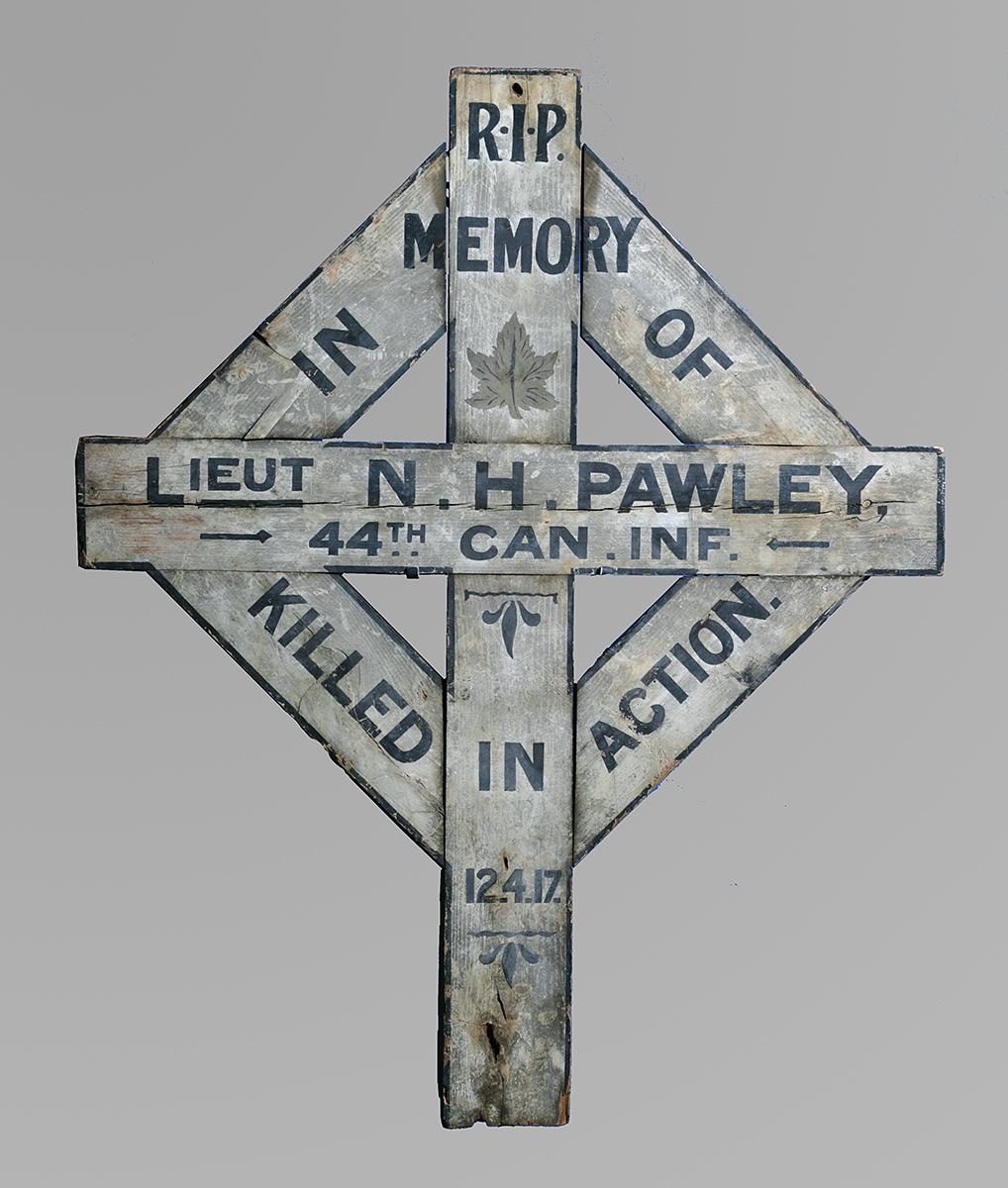
Temporary grave marker of Lieutenant Norman Howard Pawley, M.C. Killed at Vimy Ridge
After the war, the Commonwealth War Graves Commission discarded unofficial grave markers, such as this one, as it established larger cemeteries with regulation headstones.
Canadian War Museum
CWM 20030064-001
Veterans Death Cards
An alphabetical card index, dating from about 1916 to 1963, was maintained by Veterans Affairs Canada to record information on the deaths of First World War servicemen and women. The information varies over time, but generally includes name, service number, unit, date and place of death, next-of-kin, relationship and address. Some cards note cause of death, whether the death was considered to be related to military service, and the cemetery where the individual is buried. A small number of veterans from earlier conflicts — including the 1885 campaign in the Northwest and the South African War (1899–1902) — are included, along with some veterans of Imperial service.
These records have been digitized and are available on the LAC website as Veterans Death Cards: First World War.
Canadian Cemetery Records
These records consist of files for each and every cemetery in Canada where a member of the CEF is buried. The records often consist of lists of names, burial dates, various forms, and occasionally correspondence. Next-of-kin were asked to provide a suitable epitaph by completing a form, and these are found in many of the files. The files are arranged by province and within the province, alphabetically by location (LAC: RG 150, accession 1992-93/314, volumes 1–38). Note that volume 38 documents burials in the United States.
These records have not been digitized, and are only available for consultation on site at LAC. The finding aid (150-6) is a general description of these files (http://data2.archives.ca/pdf/pdf002/150-6_46246_open.pdf).
Suggested Reading: First World War
Many books have been written commemorating the dead of the First World War. The list below provides just a few examples of the types of works that exist. We recommend also looking for honour rolls and commemorative books created by regiments, townships, businesses and schools. These may include biographies and even photographs.
Books including honour rolls that have been created for a military branch, the CEF, Canada, or the Commonwealth, may also be useful in some circumstances, but tend to be simple lists of those who died in service, without accompanying biographical information.
- Cooke, O.A., et al. Rideau Remembers: North Gower & Marlborough Townships’ Sacrifice in the Great War, 1914–1918 (Rideau Township Historical Society, 2018).
- May, Robyn-Rose. Sacrifice of Angels: The Overseas Deaths of Canada’s First World War Nurses (CEF Books, 2016). Provides biographies and information about the experiences of nursing sisters during the war.
- Newman, Stephen K. With the Patricia’s in Flanders, 1914–1918 (Bellewaerde House, 2000).
- Their Name Liveth: A Memoir of the Boys of Parkdale Collegiate Institute Who Gave Their Lives in the Great War (Parkdale Collegiate Institute, 1919).
- Wigney, Edward H. The C.E.F. Roll of Honour: Members and Former Members of the Canadian Expeditionary Force Who Died As a Result of Service in the Great War, 1914–1919. E. (Ursual, 1996).
- There are also numerous commemorative websites available online. A few examples include:
- Gathering Our Heroes (gatheringourheroes.ca)
- Kenora Great War Project (kenoragreatwarproject.ca)
- Lakefield War Veterans (lakefieldwarvets.ca)
Second World War, 1939–1947
During the Second World War, and until the end of 1947, more than 47,000 Canadians and Newfoundlanders either died in service, or due to causes attributable to military service. This included members of the Royal Canadian Navy (RCN), the Canadian Army, the Royal Canadian Air Force (RCAF), and the Merchant Navy.
For those who died while serving with the Canadian military, service information is publicly available. The personnel records of those who died while in service, or for reasons attributable to service, from September 10, 1939 to December 31, 1947, are available without restriction at LAC and can be located using the database “Service Files of the Second World War — War Dead, 1939–1947.” The files consist of attestation or enrolment records, correspondence with next-of-kin, service information, and estate matters, and may include burial details. Files for members of the RCAF often include a photograph.
Complete service files can only be consulted on site at LAC. Excerpts from these files have been digitized and can be consulted on the LAC website Second World War Service Files – War Dead, 1939 to 1947 and are also available on ancestry.ca, as Canada, World War II, Records and Service Files of War Dead, 1939–1947.
Circumstances of Death Registers, similar to those for the First World War, are available at LAC for deaths that occurred in Canada for the Canadian Army, RCAF, RCN, and for military personnel involved with the British Commonwealth Air Training Plan (BCATP) — including members of the Royal Air Force, the Royal New Zealand Air Force, the Royal Australian Air Force, and various others (LAC: RG 150, accession 1992-93/314, volumes 279–302). These records can be consulted at LAC or online at ancestry.ca, as Canada, War Graves Registers (Circumstances of Casualty), 1914–1948.
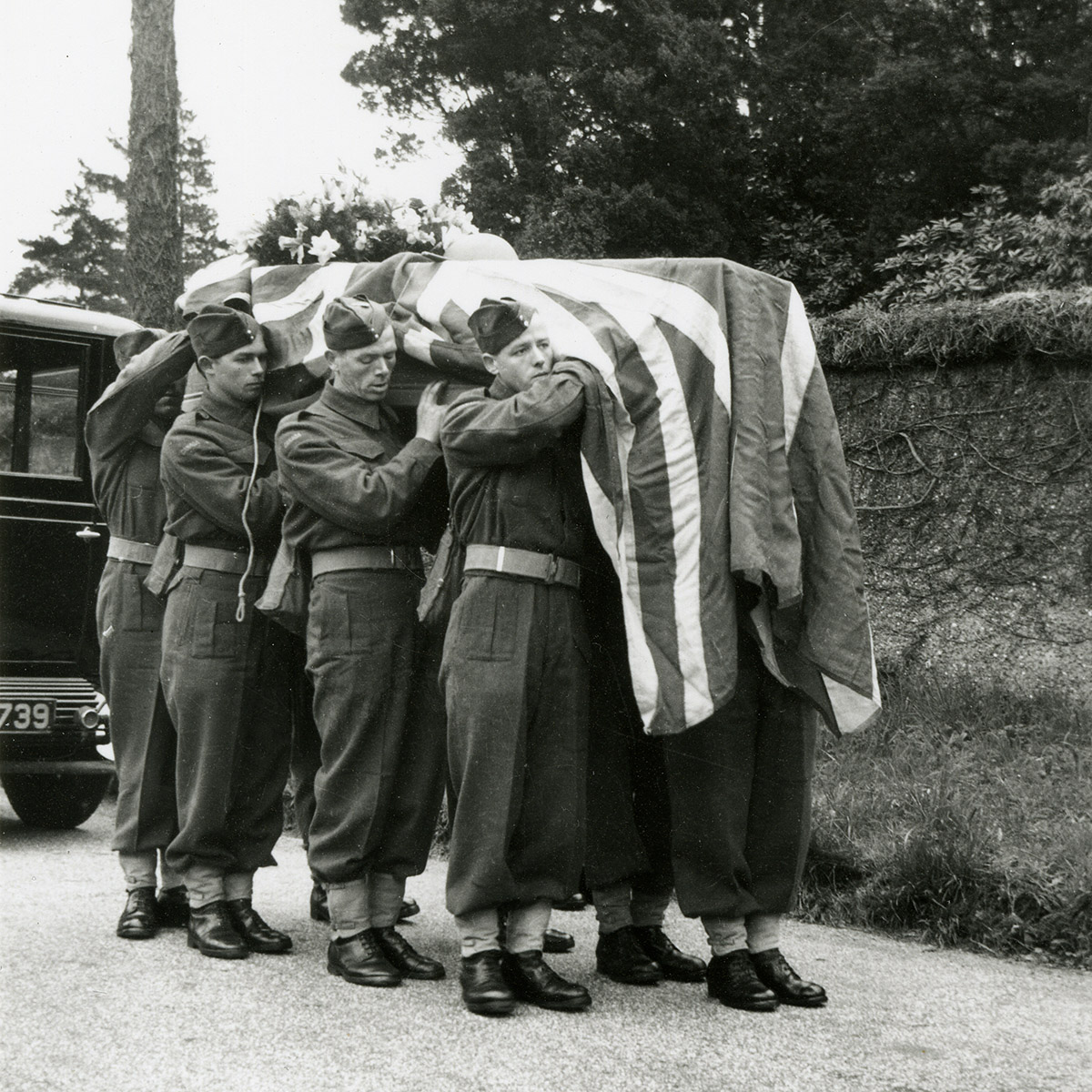
Eight Canadian soldiers carrying a coffin draped with a flag on their shoulders
George Metcalf Archival Collection
Canadian War Museum
CWM 19900228-105
Suggested Reading: Second World War
Educational institutions, banks, numerous communities, genealogical societies, and some regimental associations have prepared biographical collections of war dead, in both book form and online. The list below is a small representative sampling of the type of works available.
- Allison, Les, et al. They Shall Grow Not Old: A Book of Remembrance (Commonwealth Air Training Plan Museum, 1992).
- Barry, Bill, et al. Age Shall Not Weary Them: Saskatchewan Remembers Its War Dead (Centax, 2005).
- Buchner, Anthony P., et al. A Place of Honour: Manitoba’s War Dead Commemorated in Its Geography (Manitoba Conservation, 2002).
- D’Aoust, Robert. They Gave Their All: The Canadian Merchant Navy (Lehmann Bookbinding, 2019).
- D’Aoust, Robert. The Sacrifice We Will Not Forget (Lehmann Bookbinding, 2022). Detailed information on the 916 Canadians who died during the Dieppe Raid in August 1942.
- D’Aoust, Robert. Ultimate Sacrifice (Bob D’Aoust, 2013). More than 2,100 individuals who served with the Royal Canadian Navy, the Royal Canadian Naval Reserve, and the Royal Canadian Naval Volunteer Reserve are identified and described.
- The Veterans Affairs Canada Merchant Navy War Dead Registry is available online and files can be requested under Access to Information and Privacy.
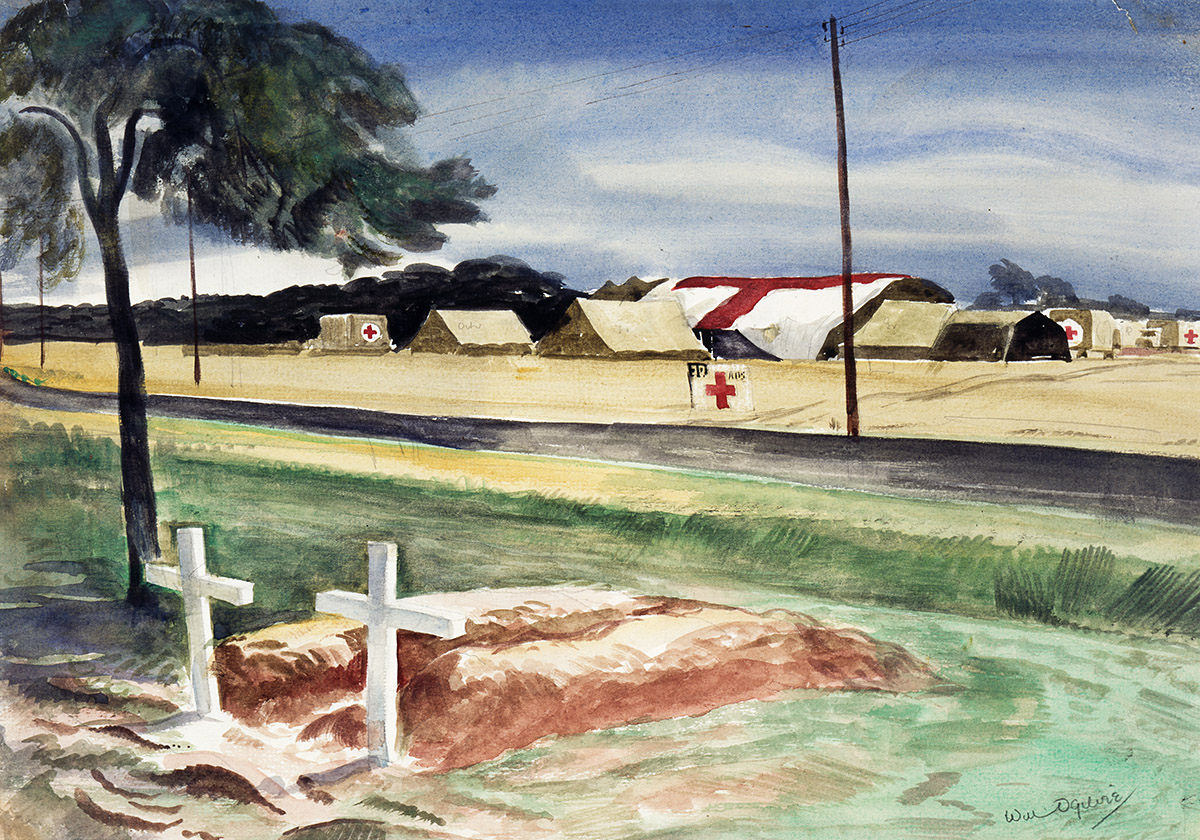
William Abernethy Ogilvie, C. M., M.B.E.
Landscape in Normandy
Beaverbrook Collection of War Art
Canadian War Museum
CWM 19710261-4604
Commemorative Books and Websites
During and immediately after the First World War, communities, churches, universities and other organizations compiled lists and biographical collections of the dead and missing. Since the release of the CEF service documents in the 1990s, a number of individuals, communities, genealogical societies, and organizations have launched projects to document and commemorate the war dead. Similar research has been carried out for those who died during the Second World War.
Numerous websites have been created to honour the war dead from both world wars. Searching by geographical location or by the name of the unit (for example, 21st Battalion CEF) will often lead to sites with biographical information on the dead and missing from both wars.
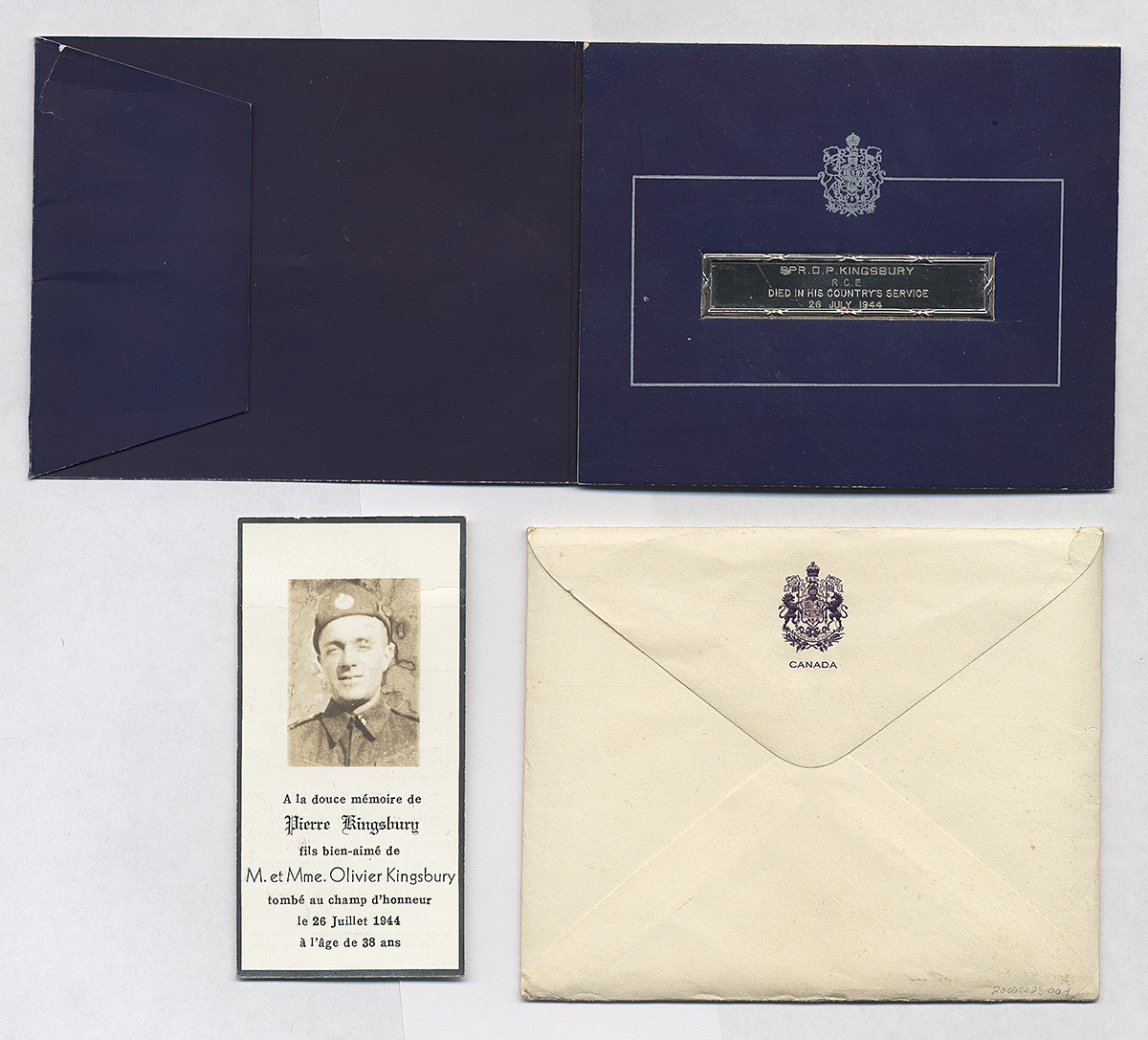
Memorial Bar and Memorial Card for Sapper Oliver Peter Kingsbury
Canadian War Museum
CWM 20060023-004
Research at Library and Archives Canada
The archival resources held by LAC are invaluable for research on any aspect of the First and Second World Wars. Researchers are encouraged to familiarize themselves with the LAC website, Collection Search, and its guides to research for both world wars: “Personnel Records of the First World War” and “Second World War.”
Canadian War Museum Resources
The Military History Research Centre (MHRC) at the Canadian War Museum houses the Hartland Molson Library Collection and the George Metcalf Archival Collection, both of which can be searched online through the MHRC catalogues. Unit histories, when they exist, are excellent resources that often include honour rolls with lists of those who died during the wars, sometimes with additional details.
They can also yield key information such as battles fought, group culture, photographs, names of others in the unit, etc. The library also offers items about uniforms, equipment, training manuals, and books relating to many aspects of service. The Museum’s archives are predominantly personal in nature, and can add an intimate perspective to official documentation held by LAC.
Key Vocabulary
War Dead: Military personnel who have died during a war. This includes those who were killed in action, and those who died of wounds, disease, accidents or other causes. An individual who died after the end of hostilities might also be included with the war dead; this depends on military and government policies and the cause(s) and date of death.
Service or Regimental Number: This was intended to be a unique identifying number for military personnel. During the First World War, Canadian Expeditionary Force regimental numbers were allotted in blocks to different areas of the country, then to individual units. Some numbers were used more than once, however. During the Second World War, the Royal Canadian Navy, Canadian Army, and Royal Canadian Air Force had their own distinct numbering systems.
Unit: An encompassing term that refers to any organized group that an individual could be assigned or attached to, including regiment, battalion, squadron, ship, hospital, etc.
Have a research question?
Check out our Frequently Asked Questions (FAQs) or contact us directly. MHRC staff can provide answers and help with your research.
With thanks to guest contributor Glenn Wright, former archivist at LAC.