Introduction
Prior to the First World War, Canada’s defence relied on the British Army and the Canadian militia. A small permanent force was created in the 1870s and by 1914 numbered about 3,000 all ranks. At the declaration of war in 1914, men rushed to join the newly constituted Canadian Expeditionary Force (CEF). In total, over 620,000 men and women served in the CEF, including over 100,000 conscripts. The CEF formed part of the British Expeditionary Force (BEF), but most Canadians served within recognizable Canadian units, be it at the battalion, brigade, division, or within the Canadian Corps.
While the CEF was effectively disbanded in 1919, a small core of experienced officers and men remained in the army during the interwar years, and later formed the basis for the Canadian Army in the next war. At the outbreak of war in 1939, Canada’s army was initially known as the Canadian Active Service Force, and from the Fall of 1940, as the Canadian Army. Over the course of the war the Army grew to a force of 730,000 men and women, fought in multiple theatres of war, and made significant contributions to the success of the Allied cause.
This guide will illustrate the process of researching an individual’s service, from the essential starting point of service documents to supporting resources for detail and further discovery.
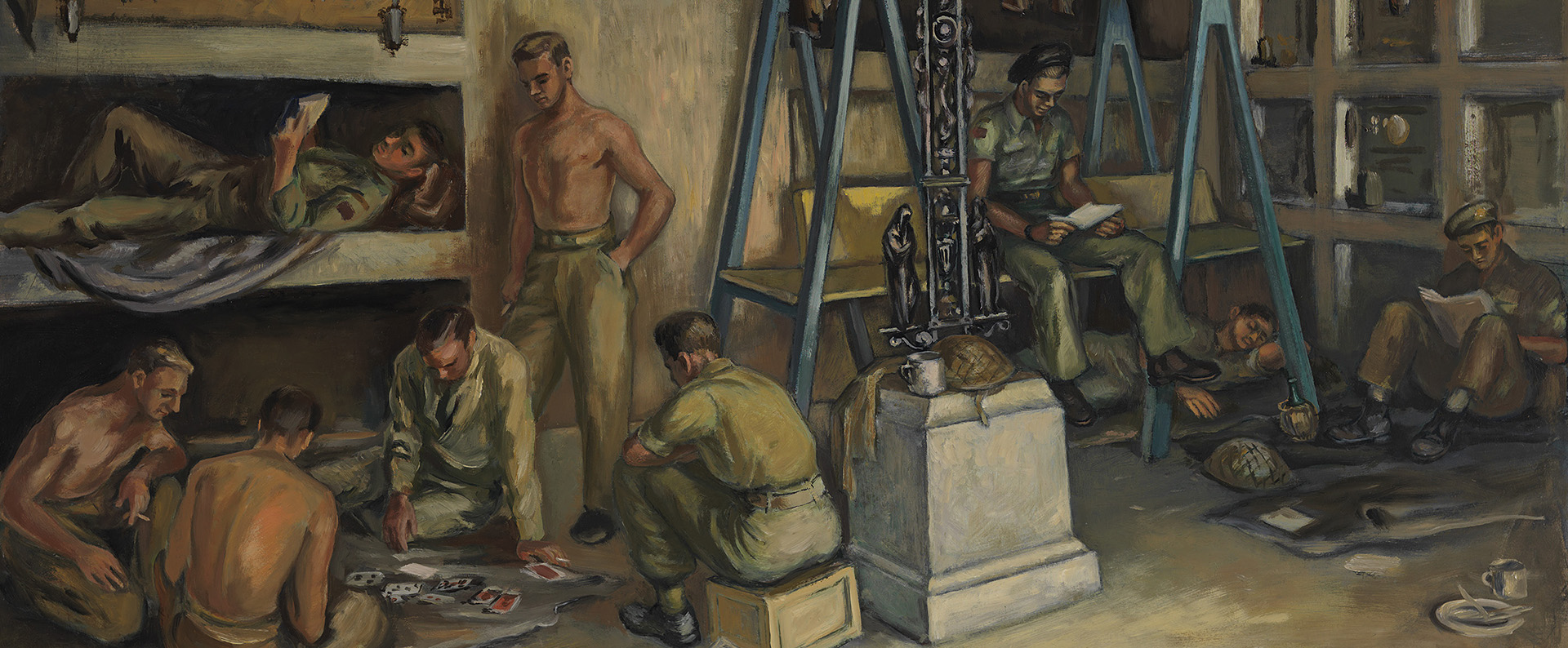
Image at top of page:
George Tinning
In the Vault of the Cemetery
Beaverbrook Collection of War Art
Canadian War Museum
CWM 19710261-5495
Helpful hint
See LAC’s Military Abbreviations used in Service Files page.
First World War, 1914–1919
The CEF was Canada’s fighting force in the war and consisted of many different services. In addition to the infantry, CEF troops consisted of artillery, railway, forestry, medical and dental, transport and supply, cavalry, engineers, veterinarians, ordnance, chaplains, etc.
The service files of those who served with Canada have been preserved at Library and Archives Canada (LAC). For members of the CEF and a few other groups, they are digitized and searchable under LAC’s First World War Personnel Records database. This free database provides a digital image of the individual’s Attestation Paper, or Officer’s Declaration, and a link to digital images of all their service documents. LAC’s First World War section includes information on how to interpret the key service file documents.
Tip: Search by service number, or consider spelling variations when searching by name.
In a service file the most important service documents are:
- Attestation Paper / Officer’s Declaration Paper / Particulars of a Recruit: This document was an application, and/or contract, to serve. It identified an individual, distinguished them from other men and women with similar names, and captured essential personal information including previous experience, next of kin, and religious denomination.
- Casualty Form — Active Service: This form, or any variation of it, is the most important document on file. It recorded the ‘where’, ‘when’, and ‘with what unit’ details of service. It included their date of arrival in England (often with the name of the ship), initial postings to training camps in England (Shornclifffe, Bramshott, Witley, etc.), dates of postings “overseas” in France or Belgium, of joining a unit, promotions, reductions, and transfers. It also included casualty information, hospitalization, and the names and locations of the hospitals where they were treated. At the end of the war, it documents their demobilization, departure for home, and discharge.
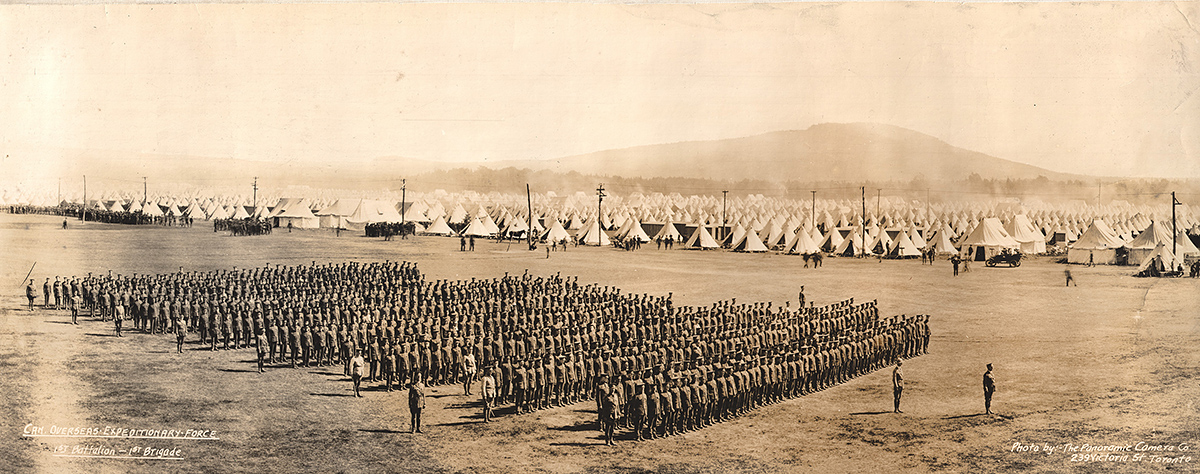
Canadian Overseas Expeditionary Force 1st Battalion 1st Brigade, Camp Valcartier 1914
George Metcalf Archival Collection
Canadian War Museum
CWM 19740416-003
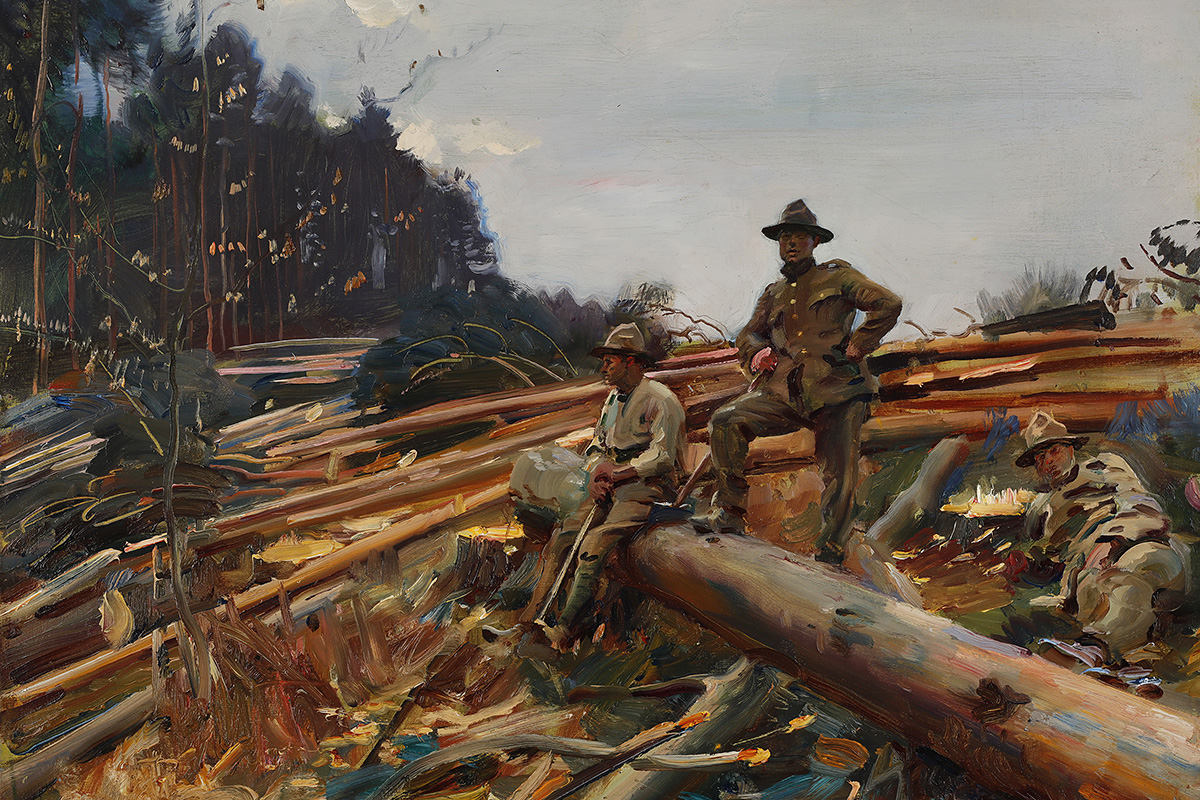
Alfred Munnings
Lumbermen Amongst the Pines
Beaverbrook Collection of War Art
Canadian War Museum
CWM 19710261-0481
Service files also include various forms, index cards, and documents that capture information about the individual and their contribution to the war: a certificate of service, a medal card, etc. Documentation relating to separation allowance and assigned pay can be useful in identifying next of kin and relationships. The medical and health condition of the individual before, during the war, and at discharge was also recorded in detail. Note that not all service documents were retained. Rather, two types of information were prioritized for determining pension eligibility: proof of service in the military (including dates, rank, postings, and pay), and medical/health condition during service.
As Newfoundland did not join Canada until 1949, the Royal Newfoundland Regiment and the Newfoundland Forestry Corps served with the British during the First World War. The service files for these men are available at LAC, or digitally through The Rooms. Many Newfoundlanders as well as Americans also joined CEF units.
Limits of documentation
Wartime records were created and kept for specific purposes, with contemporary ideas of importance. For example, ethnic origin was not recorded and a hometown might only be inferred through the address of next of kin, who may only be identified as Mrs. [husband’s name]. The language of administrative documentation was almost always English, regardless of the preferred language of the service person. In addition, some underage and overage soldiers gave a second name, while some names were misspelled in the administrative process.
Did you know?
Officers, including Nursing Sisters and Chaplains, were not assigned service numbers.
Men who volunteered in August 1914 were assembled at Valcartier Camp in Quebec and re-attested. As a result, the place of attestation for more than 30,000 individuals is recorded as Valcartier, Quebec!
Second World War, 1939–1945
In total, approximately 730,000 men and women served in the Canadian Army during the Second World War. During six years of war, the Canadian Army served in multiple theatres including the Pacific, Mediterranean, Italy, Northwest Europe, the defence of Britain, Iceland, Canada, and other smaller theatres of war. The Canadian Army was a complex organization with multiple areas of specialization including infantry, artillery, armoured, engineers, service corps, medical, ordnance, postal, and intelligence, etc.
As with the CEF, the service files for those who served in the Canadian Army are held by Library and Archives Canada (LAC). All post-1919 service files are subject to privacy legislation; see LAC’s Requests for Military Service Files page for the rules and procedures when accessing non-open records. Records of those who died in service between 1939 and 1947 are available without restriction.
Second World War service files are typically more extensive and personal than those from the First World War, as all documents relating to an individual were retained. In the case of those who died in service, this can include pay books and copies of correspondence with next-of-kin. The documentation between the two wars is otherwise similar as records were likewise required to prove service, pay, and medical details for pension purposes.
The most important documents are:
- Attestation / Enrolment Paper: This document was an application, and/or contract, to serve. The form captures personal information such as age, date and place of birth, parents, where resident, education, employment, medical and health information, as well as regiment or unit, and service number.
- Record of Promotions, Reductions, Transfers, Casualties, Reports: The key chronological summary of wartime employment, from date of enlistment to discharge. This document records the ‘where’, ‘when’, and ‘with what unit’ details of service.
- Service and Casualty Form: Includes training, postings, hospitalization, and discharge.
Second World War service records differ significantly from those of the First World War and include more information on a soldier’s personal and family history. Various forms and correspondence relating to his education and pre-war employment, medals, last pay, and for those who died, estate documents. Their medical and health condition, before and during the war, is documented in detail, which impacted future pension claims.
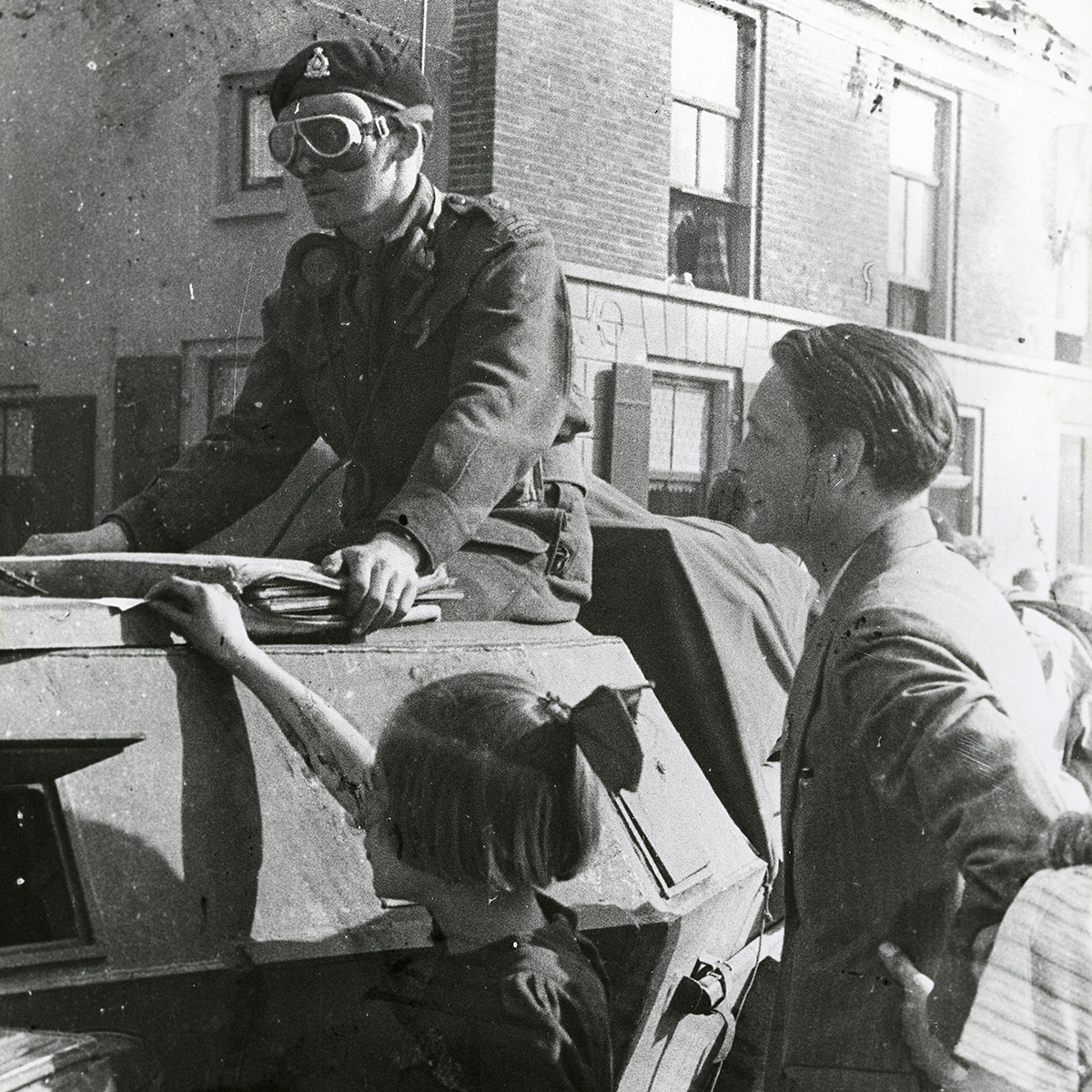
Group Commander sitting in a personnel carrier — Liberation of Holland photo collection
George Metcalf Archival Collection
Canadian War Museum
CWM 19790549-025
Museum Resources
The Military History Research Centre (MHRC) at the Canadian War Museum is the location of the Hartland Molson Library and the George Metcalf Archival Collection, both of which can be searched online through the MHRC catalogue. For the promotions of officers, check The Quarterly Army List. Consulting a unit history, if one exists, can yield key information such as battles fought, group culture, photos, names of others in the unit, etc. The library also offers items relating to uniforms, equipment, training manuals, and specific books related to many aspects of service. The museum’s archives are predominantly personal in nature and can add an intimate perspective to the official documentation held by LAC.
Tip: Search by unit, training camp, hospital, or any other detail from a service file to find regimental histories, soldier’s published memoirs, camp newsletters, diaries, personal photo albums from a particular unit, etc.
Try these search terms: Regimental History, Commemoration, Casualties, 1914–1919, 1939–1945
During the MHRC hours of operation the library is open to browse and archival consultation appointments can be booked. To request archival material, contact mhrc-crhm@warmuseum.ca with your name, preferred date(s), and the catalogue control and call number for each item requested. Most library material is also available throughout Canada by interlibrary loan. Research copies or high-resolution images can also be ordered.
The artifact collections of the Canadian War Museum, from cap badges to tanks, can be searched online through the artifact catalogue. This catalogue is the access point for the war art held by the museum, over 13,000 pieces, including depictions of individuals, ships, battles, hospitals, etc. The museum’s website also offers resources including online exhibitions and a text-searchable collection of over 140,000 Second World War newspaper clippings.
Service Medals, Decorations of Honour, and Awards
Military medals were awarded according to specific criteria and convey particular meanings. Pins and badges could also serve similar functions. Service (or campaign) medals recognized time and place of service, meritorious service decorations were awarded for exemplary acts, and valour (or gallantry) decorations were awarded for demonstrated courage. See The meaning of medals webpage to discover the people and stories behind medals held by the Canadian War Museum. Medals and Decorations by Veterans Affairs offers profiles of most medals and ribbons, and searching medal* or honour* in the MHRC catalogue yields in-depth published resources.
For the First World War, service medals may include the 1914 Star, the 1914–1915 Star, the British War Medal and the Victory Medal. For the Second World War, members of the Canadian Army could receive the 1939–1945 Star, one or more Stars for service in particular theatres of war, the Defence Medal, the Canadian Volunteer Service Medal, and the War Medal 1939–1945. Valour awards for both world wars include the Victoria Cross (VC), the Distinguished Conduct Medal (DCM), the Distinguished Service Order (DSO), the Military Medal (MM), the Military Cross (MC), Mentioned in Dispatches (MID). Bars on the ribbon typically indicate that the medal was awarded more than once.
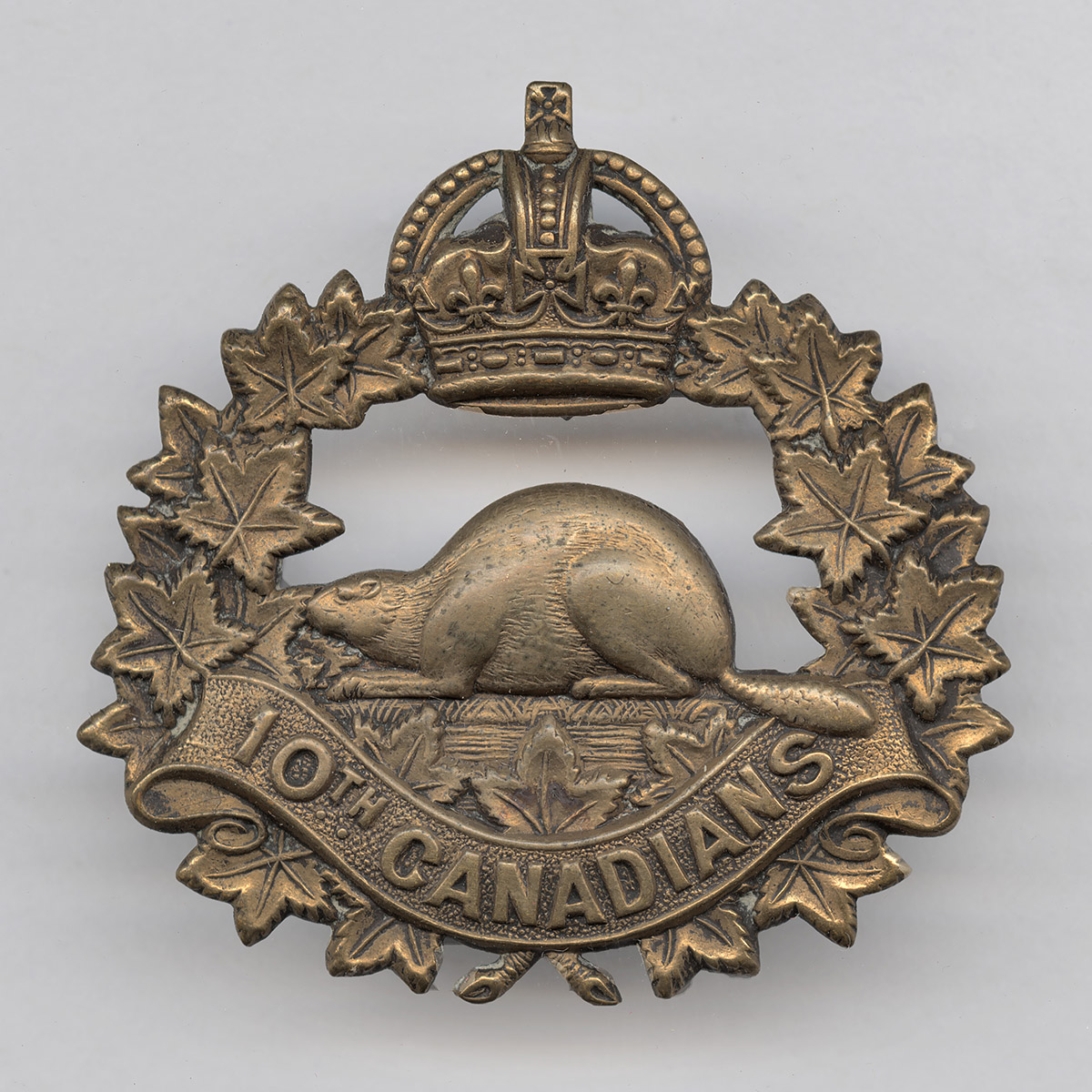
Cap Badge of the 10th Canadian Infantry Battalion
Canadian War Museum
CWM 19920166-1444
War Dead
The Canadian Virtual War Memorial by Veterans Affairs Canada is a searchable database of Canada’s war dead. In addition to providing a standardized profile, it also invites the public to attach photos, newspaper clippings, and other materials in commemoration. Burial and commemorative information is also available through the Commonwealth War Graves Commission, the organization responsible for First and Second World War graves and monuments. At LAC, documentation for specific time periods includes the Circumstances of Death and War Graves Registers, and Veterans Death Cards.
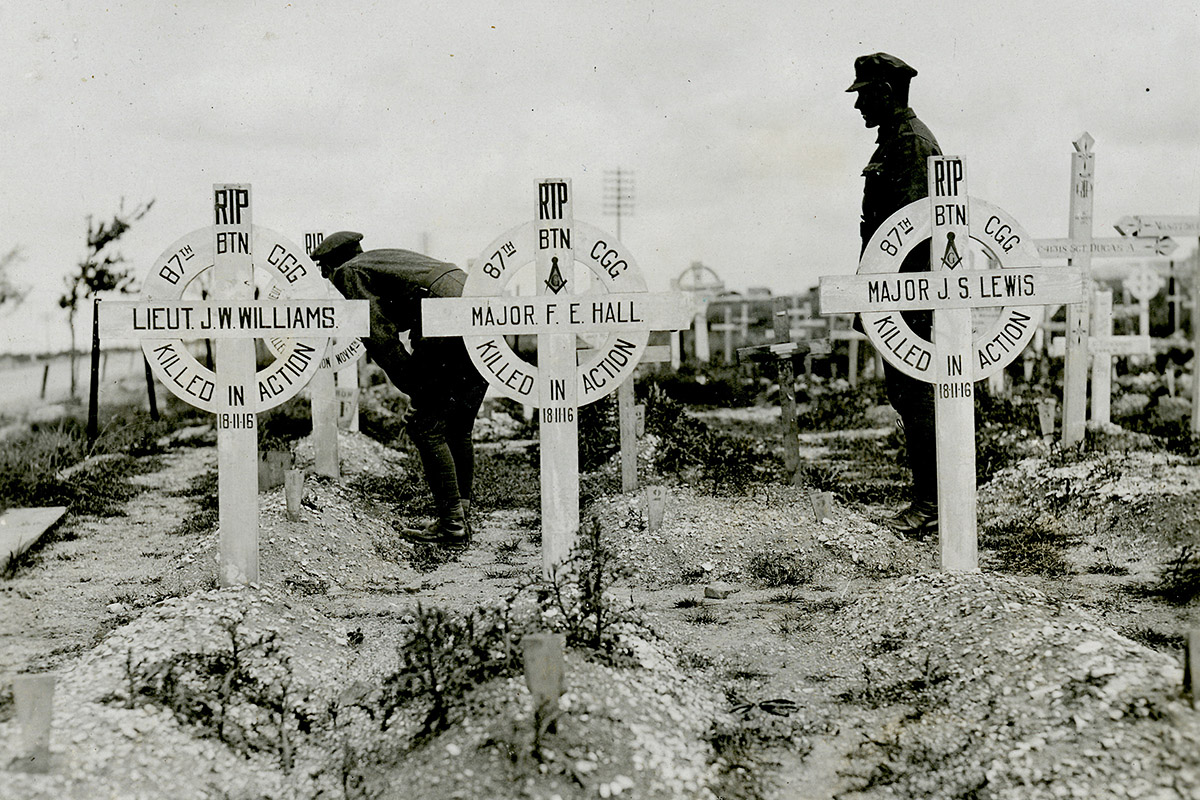
Canadian graves on the Albert Bapaume Road
George Metcalf Archival Collection
Canadian War Museum
CWM 19930012-695
Other Useful Records at LAC
Guide to Sources relating to Units of the Canadian Expeditionary Force: An index to all files in the custody of LAC relating to specific units of the CEF.
War Diaries: The daily record of unit activities in the field, including administration and operations. While individuals are rarely mentioned by name, these can provide useful context.
Hospital Admission and Discharge Records: Service file information can be combined with hospital record books to follow a wounded soldier through the medical system.
Military Medals, Honours and Awards, 1812–1969: An index to military honours and awards, with citation cards.
Suggested Reading
- Official history of the Canadian Army in the Second World War, v.1 and v.3 C.P. Stacey; v.2 G.W.L. Nicholson, (Govt. of Canada, 1955–1960). 3 volumes, organized by theatre of war.
- Cook, Tim. At the sharp end: Canadians Fighting the Great War, 1914–1916 (Viking, 2007)
—. Shock troops: Canadians Fighting the Great War, 1917–1918 (Viking, 2008)
—. The necessary war: Canadians fighting the Second World War 1939–1943 (Penguin, 2014)
—. Fight to the finish: Canadians in the Second World War, 1943–1945 (Penguin, 2015) - Nicholson, G.W.L. Canadian Expeditionary Force, 1914–1919: official history of the Canadian Army in the First World War (McGill-Queens University Press, 2015)
- Wright, Glenn. Canadians at war, 1914–1919: A Research Guide to War Service Records (Global Heritage Press, 2010)
Key Vocabulary
Casualty: Typically means war dead, wounded, missing, or sick. Note that casualty counts vary widely depending on the inclusion/exclusion criteria and the accuracy of record-keeping.
Service file: Documentation relating to an individual’s wartime service from enlistment or enrolment to discharge, including personal information, training, postings and service.
Service or regimental number: This was intended to be a unique identifying number. For the CEF, regimental numbers were allotted in blocks to different areas of the country, and then to individual units. Second World War regimental numbers used a Military District letter prefix, 1–7 (A–G) and 10–13 (H–M), to reflect where a unit was raised. A number does not necessarily correspond to the unit an individual served with overseas, due to transfers and reorganizations.
Unit: An encompassing term that refers to any organized group that an individual could be assigned or attached to, including regiment, battalion, squadron, ship, hospital, etc.
Have a research question?
Check out our Frequently Asked Questions (FAQs) or contact us directly. MHRC staff can provide answers and help with your research.
With thanks to guest contributor Glenn Wright, former archivist at LAC.