Soccer and war: Military history and the beautiful game
Soccer has long had an important place in Canada’s military history and in the lives of people touched by war. It has been therapeutic, inspiring, sustaining, even commemorative.
Here are five objects and images that tell us something about the relationship between soccer and war.
Canadian Corps Championships, 1918
Soccer played an important motivating role in both world wars. It relieved stress and entertained. Behind the front lines, commanding officers often encouraged games to improve fitness and boost morale. Military leaders also organized large-scale sports days to foster friendly competition.
Shown here are members from the 27th Battalion (Winnipeg) football (soccer) team, who took first place at the Canadian Corps Championships in France on July 1, 1918. The Canadian Corps Championships was a large one-day event that included competitions in a variety of sports, as well as lighter fare like sack races and clown competitions.
About 50,000 Canadian soldiers took part as either participants or spectators, and the event also attracted journalists and dignitaries, including Prime Minister Sir Robert Borden.
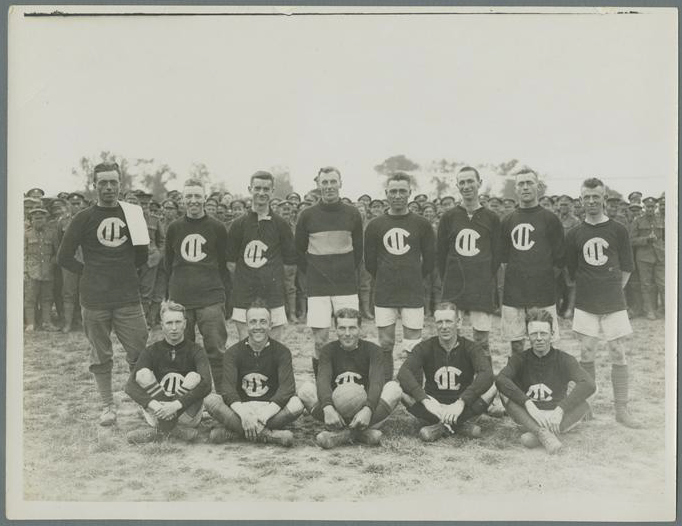
The winners of the Canadian Corps football championships held at the Canadian Championship meet, 1918.
Sports Day Photo Collection, Canadian War Museum, 197000140-163_12a
Therapy through sport
In addition to encouraging teamwork and raising morale, some military leaders considered soccer to be therapeutic. Physically wounded men often took part in games as part of their recovery. In some instances, commanding officers viewed soccer as an antidote for psychological trauma.
Following the Battle of Mount Sorrel — a two-week struggle that cost 8,000 Canadian casualties — officers organized soccer games to lighten the mood. Taken in July 1916, this team portrait from the No. 3 Canadian Field Ambulance shows men who had weeks before risked their lives and suffered losses while administering aid to the wounded and dying under a rain of shellfire.
For a brief moment, the men could set aside their medical work to play.
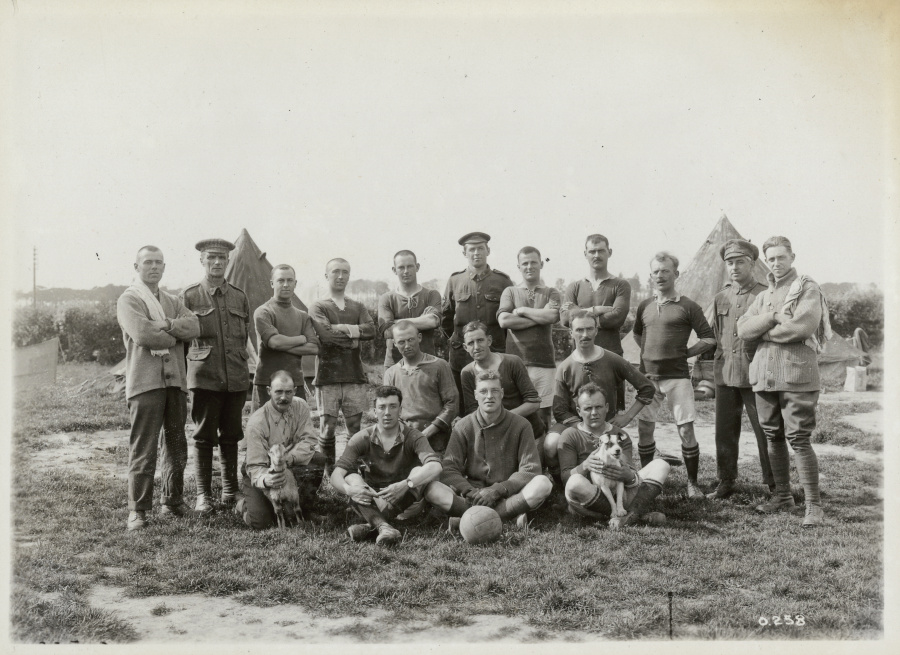
No. 3 Field Ambulance Football Team.
Canadian War Museum, 19920044-228
Soccer as survival mechanism
While soccer provided relief for soldiers serving at the front, it also sustained prisoners of war.
We are used to seeing soccer played in enormous World Cup venues and local parks. But it has also been played under conditions of danger and privation.
During the Second World War, the physical and psychological conditions inside of German camps was notoriously difficult. However, some prisoners of war found respite in sports.
German forces captured Jack Powerful Griss of the Royal Hamilton Light Infantry during the failed raid at Dieppe, France in 1942. He spent the next three years as a prisoner of war. At Stalag VIII-B, Griss endured countless deprivations, but in letters home to his wife, he kept a positive tone and recounted soccer matches with fellow inmates.
After the War’s end, Griss held on to items he obtained during his captivity, including these two photographs: the first of a soccer match in progress, and the second a prisoner of war team photo. The men, gaunt in their appearance, cannot hide the hardships of captivity.
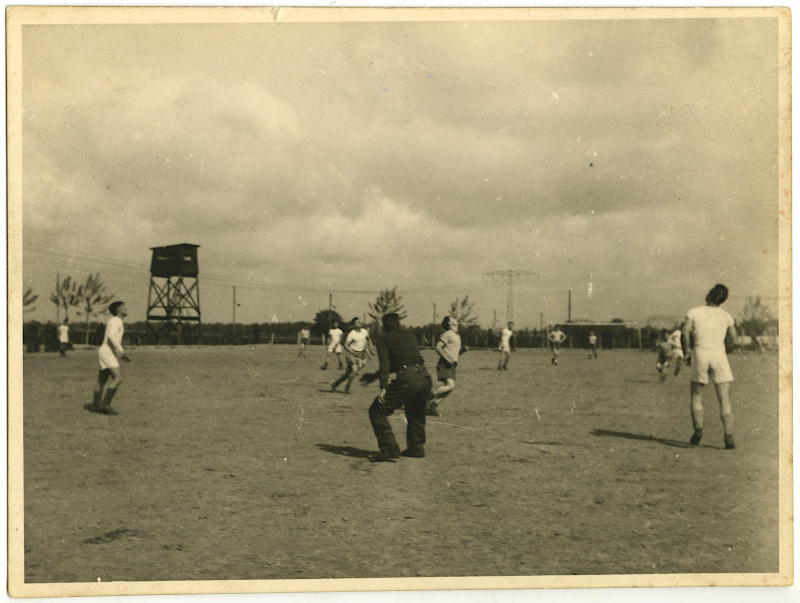
Prisoners of war playing soccer under the gaze of a guard tower.
Canadian War Museum, CWM 19740246-013_8
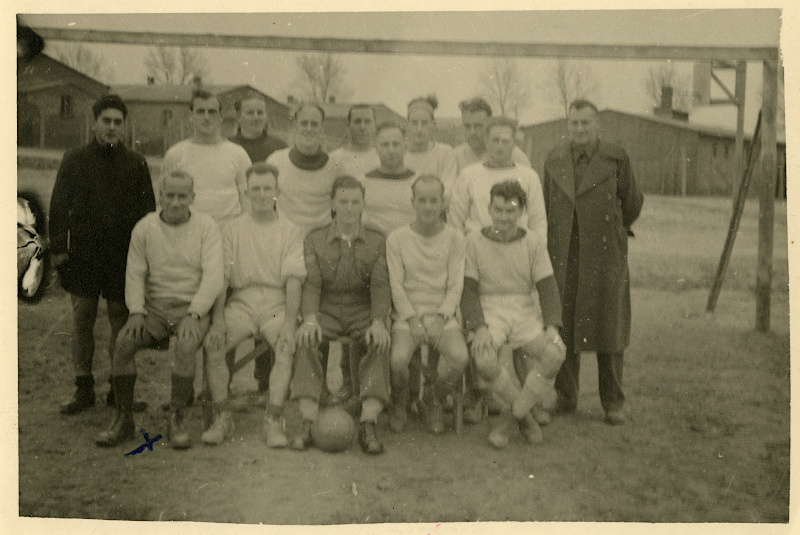
Prisoner of war team photo (Griss is seated at far left, bottom row).
Canadian War Museum, 19740246-013_9
Honouring the sacrifice
The Dutch soccer club Cambur created the 80th Anniversary Liberation shirt in 2025 to mark the city of Leeuwarden’s liberation from German occupation by the Royal Canadian Dragoons (RCD) on April 15, 1945.
Inspired by the traditional RCD uniform, the jersey features maple leaves on the front and the RCD badge on its reverse. An example of the myriad forms of commemoration, this jersey links the past to the present and reinforces the bond that has existed between Canada and the Netherlands since the Second World War.
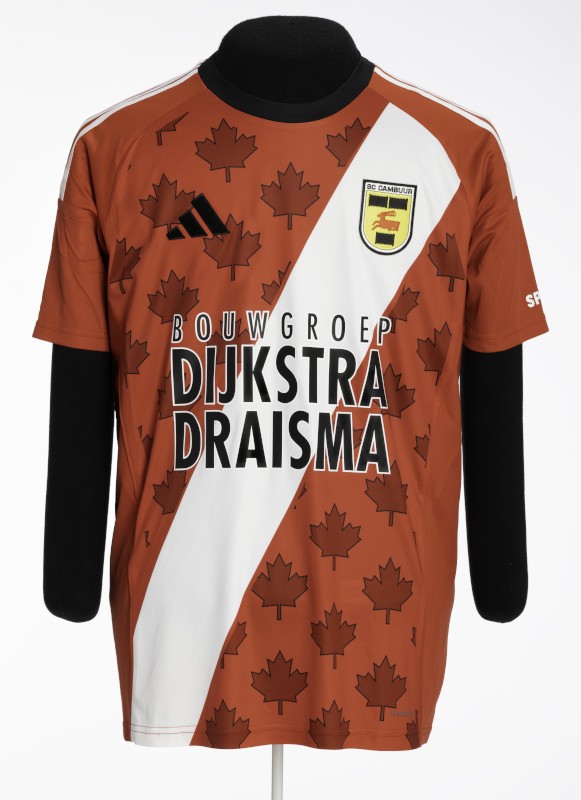
Canadian War Museum, 20250215-001
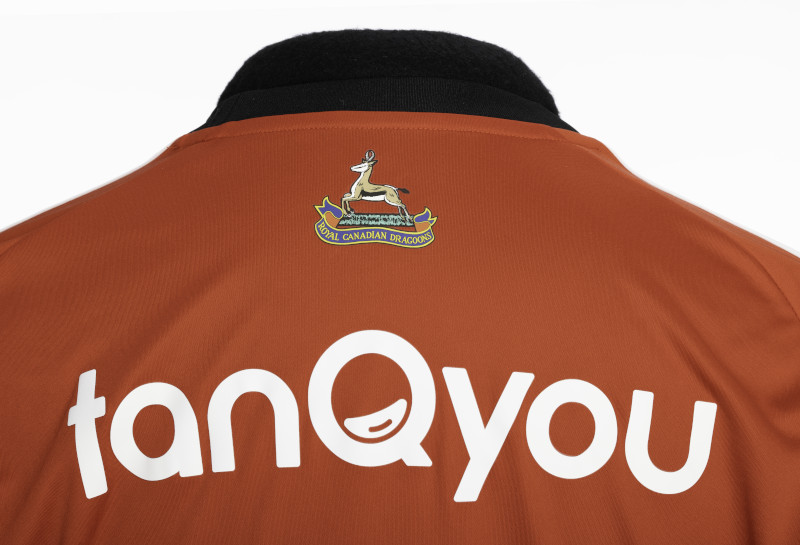
Canadian War Museum, 20250215-001
Surviving the peace
This drawing illustrates the impact of war on the everyday lives of children, including the ways in which children play. Soccer is immensely popular across the globe. The sport requires only a ball and some space, making it accessible to children with limited material resources.
However, war can rob children of many things, including a safe space to play. This drawing is one of several created by children in Bosnia between 2002 and 2003.
In the aftermath of the Yugoslav Wars of the 1990s, a joint UN-NATO led stabilization , supported by the Canadian Armed Forces (CAF), worked to maintain stability in the region. In addition to clearing landmines left from the War, members of the CAF provided mine awareness education. During this process, some school children were asked to draw their experiences with mines.
In this drawing, a child with a missing leg stands on the edge of a minefield littered with a shoe, a bloodstain, and a soccer ball. Translated, the child’s caption reads: “We survived the war, we will also survive the peace.”
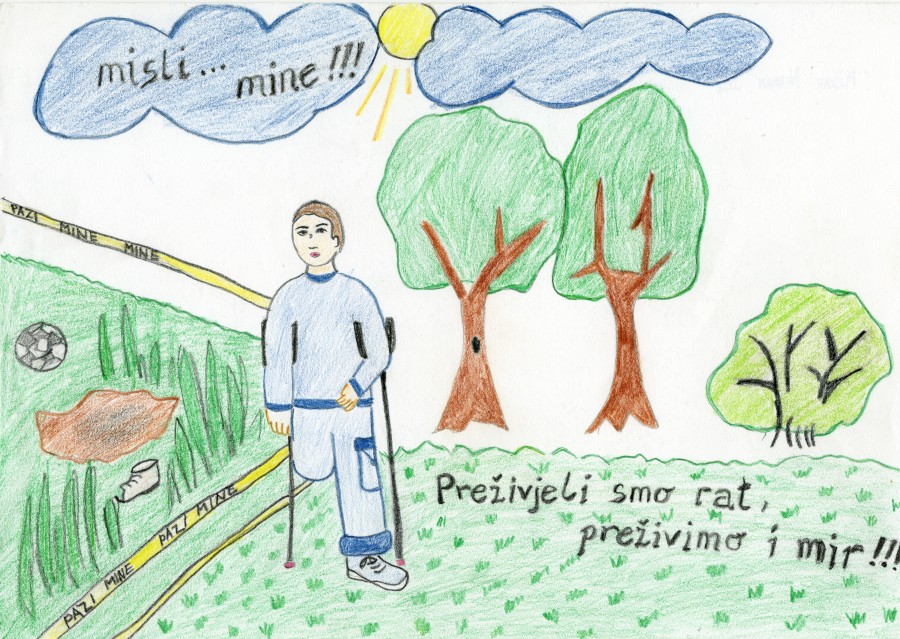
“We survived the war, we will also survive the peace.”
Canadian War Museum, 20130650-008
The relationship between soccer and war is a fertile ground for understanding our military past. Images and objects are gateways to larger stories, moving well beyond the game to reveal more about the experience of war through the eyes of both soldiers and civilians.
Image gallery

Teresa Iacobelli
Dr. Teresa Iacobelli joined the Canadian War Museum in 2022 as First World War Historian and the curator of Gallery 2: The South African and First World Wars. Her research examines Canada’s military history from 1885 to 1931, and contributes to exhibitions and other projects. She is especially interested in the relationships between war, national identity, and social memory.
Read full bio of Teresa Iacobelli