In Enemy Hands
Introduction
Given the size of the Canadian Expeditionary Force (CEF) and the nature of the First World War, the number of Canadian prisoners of war (POWs) was surprisingly small. According to the Report of the Ministry, Overseas Military Forces of Canada, published in London in 1919, some 3,747 men, including 236 officers, were captured by enemy forces and interned in Germany, or in occupied France. The Overseas Ministry reported that 301 died in captivity; 438 were repatriated prior to the end of hostilities; and 100 men, including one officer, escaped during the war.
Throughout the Second World War, about 9,700 Canadian military personnel found themselves in enemy hands. Some were airmen shot down over occupied territory, although soldiers were the largest number of prisoners. About 1,900 Canadian soldiers were captured at Dieppe in August 1942, and others would be captured in Italy, France, and northwestern Europe. Close to 1,700 Canadians became prisoners of the Japanese following the fall of Hong Kong in December 1941, while a smaller number were captured later in the war. Canadian sailors and merchant mariners were also taken prisoner.
German and Italian prisoners of war — about 37,000 in number — were held in 30 camps and numerous sub-camps located throughout Canada, both during and immediately after the Second World War.
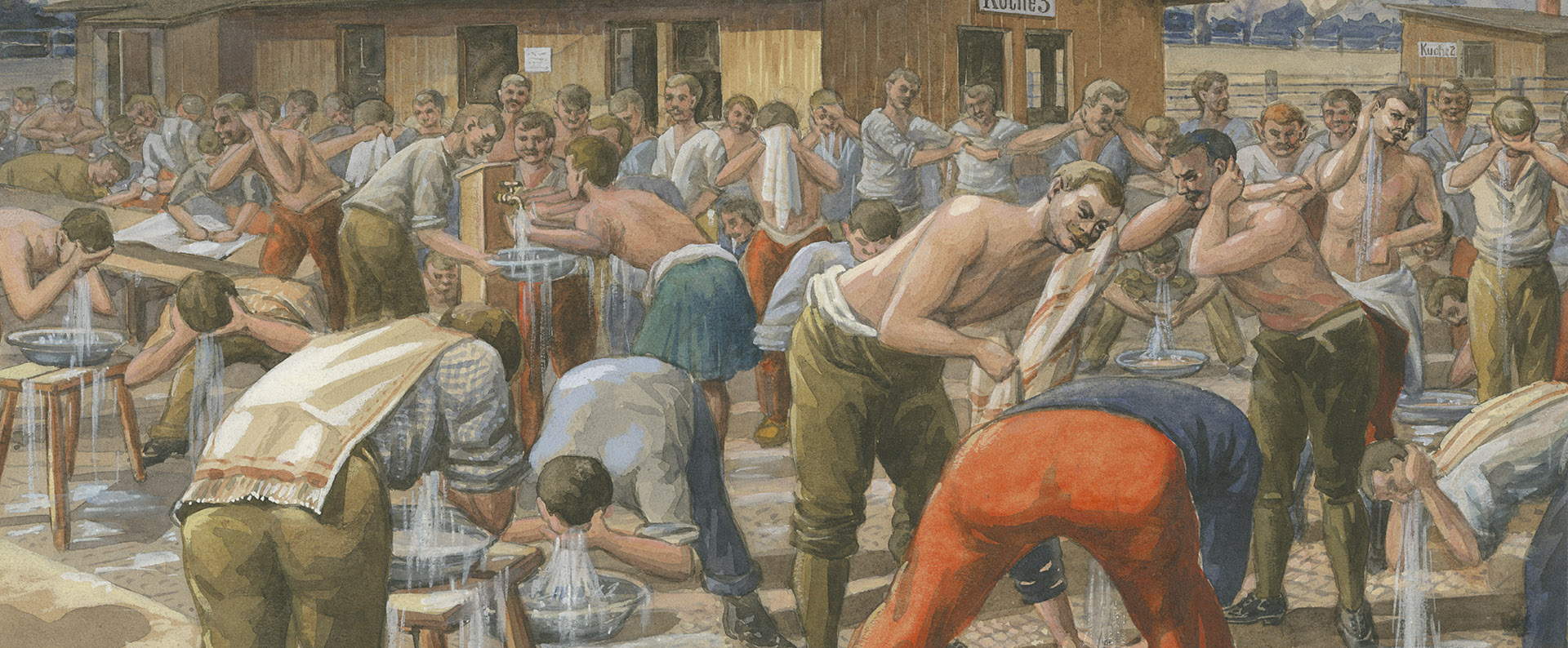
Image at top of page:
Arthur Nantel
Every Day in the Week, 6 a.m. Giessen
Beaverbrook Collection of War Art
Canadian War Museum
CWM 19710261-0500
Helpful hint
See LAC’s Military Abbreviations used in Service Files page.
First World War, 1914–1919
CEF service records make little reference to an individual’s status as a prisoner of war. Upon returning to England, however, all prisoners of war were interviewed by officials of the Canadian War Records Office for intelligence gathering, and to assess the conditions under which internees had lived and worked. POWs released at the conclusion of hostilities were interviewed at a special reception centre established by the British government at Ripon, England, where they were given a medical exam, new kit and clothing, their pay, and up to three months’ leave in the United Kingdom. They were also identified for priority return to Canada.
In 1918, the British government established a Committee on the Treatment by the Enemy of British Prisoners of War. More than 3,000 British and Commonwealth POWs were interviewed about their experiences in captivity. Some files include individual reports and forms such as “Statement of Extraordinary Experiences in German Internment Camps,” as well as handwritten reports, correspondence, and, occasionally, a small postcard- sized document recording the name and rank of the POW, his place and date of capture, the names of any hospitals and camps in which he was confined, and the duration of his stay at each location.
The Committee’s records — held at the National Archives of England and Wales and described as the War Office: Miscellaneous Unregistered Papers, First World War (War Office 161) — include interview transcripts and references to more than 300 Canadian POWs. The database is searchable online by name, and files can be downloaded free of charge to registered users. POWs are identified by their full name, regimental number, date and place of enlistment, residence of next-of-kin, and the camp or camps where they were held captive. A selection of these records is available at Library and Archives Canada (LAC) (RD 9-D-1, volumes 4731, 4737 – 4740, and RG 24, volume 23189).
Several lists of the names of POWs, compiled at various times during the War, are available at LAC, and generally include name, rank, regimental number, unit, country of birth, where incarcerated, who escaped, who was repatriated, and who died in Germany and in occupied France. A third file in the same volume is a list of the missing, 76 pages in length, documenting men who were thought to be POWs — although some had probably been killed in action (reference: LAC, Record Group 24, volume 23189, file “CEF POWs to July 31, 1918” and “CEF POWs”).
To find basic information on Canadian POWs, the place to start is Edward H. Wigney, Guests of the Kaiser: Prisoners of War of the Canadian Expeditionary Force, 1915–1918 (CEF Books, 2008). The book contains an alphabetical list of all POWs, including full name, service number, rank, unit, date when taken prisoner, date of release, where discharged and, in some cases, date of death, even if death occurred decades after the War. Wigney also includes a list of all memoirs published by Canadian POWs, as well as short biographies of the 100 men who escaped during the War. Note that Canadians who served with the British flying services and subsequently became POWs are not included. Guests of the Kaiser is available for consultation in the Canadian War Museum’s Military History Research Centre and may also be available at other libraries.
Private Alexander Millar Allan was wounded at the battle of Mont Sorrel and went missing between the 2nd and 4th of June 1916. He lay injured on the battlefield for two days, surviving multiple artillery bombardments, before becoming a prisoner of war and eventually being repatriated to England, and later Canada, during the war.
“… for I walked right into a number of Germans. Not a soul spoke they all watched me with staring eyes. I looked at them for a few minutes examining the focus of every one, then signed to them that I wanted water. Still nobody spoke; when I saw that they weren’t likely to have water to give me, I crawled on my way through them all, and not one offered to stop me. I continued on my way with the idea of getting to a place where I knew we had water; very soon I met an officer and some men; when he saw me he yelled ‘the enemy’! Now, I thought, here is where I get it; he calls me the enemy; not much hope there.”
“I slid down on to the ground and waited to see what was going to happen. He gave a few sharp orders. I looked up to see what he was about to do and I must say I was surprised; he was looking at me with sympathy clearly marked on his face. His orders were to one of his men to take me along to the dressing station and see that I was properly attended to.”
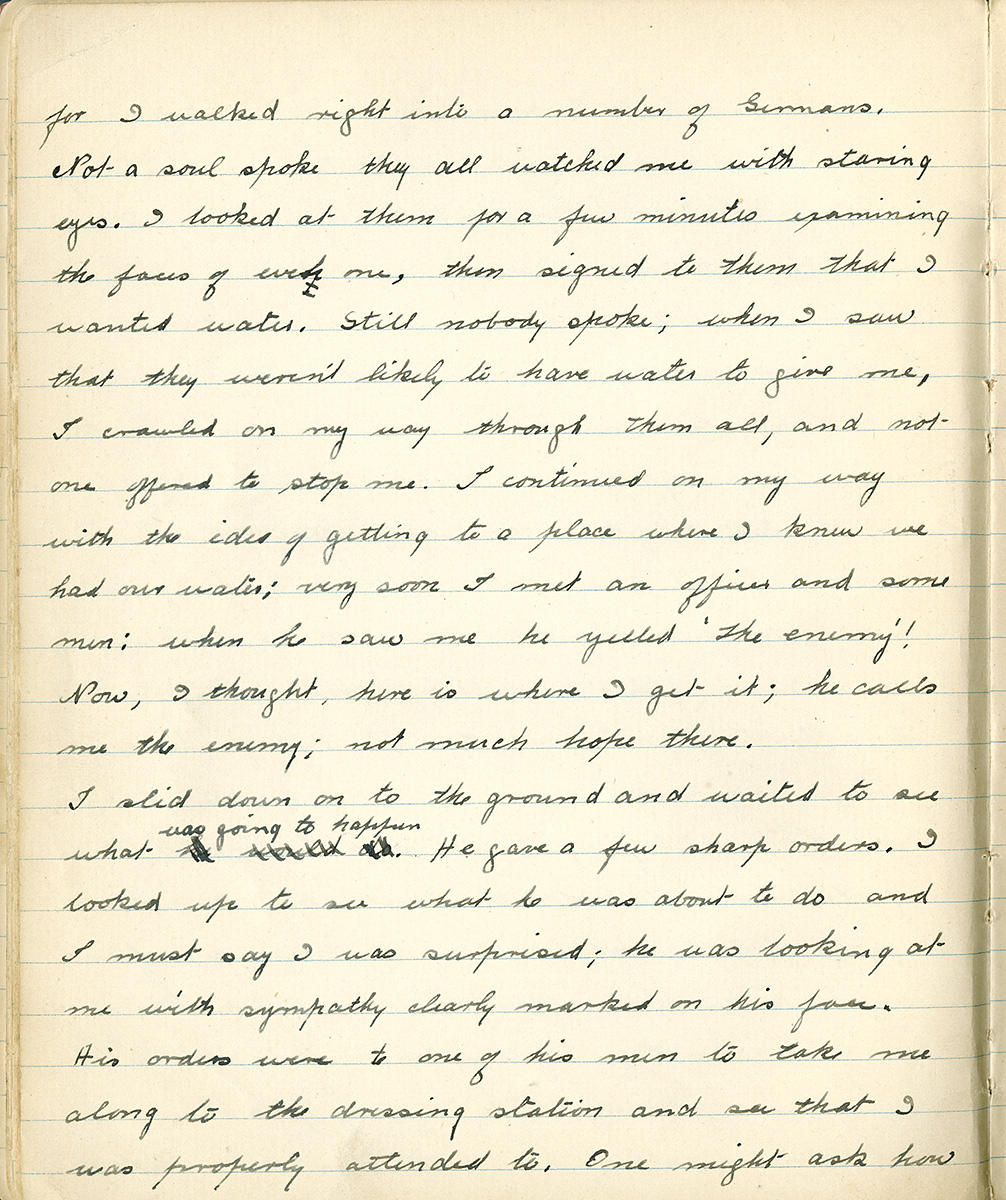
What happened to me on June 2nd 1916
Private Alexander Millar Allan
George Metcalf Archival Collection
Canadian War Museum
CWM 20140001-001
International Committee of the Red Cross
As early as August 1914, the International Committee of the Red Cross (ICRC) had established an International Prisoner of War Agency in Geneva, Switzerland, to collect and disseminate information on prisoners of war from both sides of the conflict. Its records — Prisoners of the First World War, the ICRC Archives — are searchable by surname and are available online. The site includes a list of camps in Germany and in occupied France, ICRC reports on camp conditions, some requests from families for information on a POW, and additional reference material.
Although the ICRC also has records relating to Second World War POWs, these records are not available to the public.
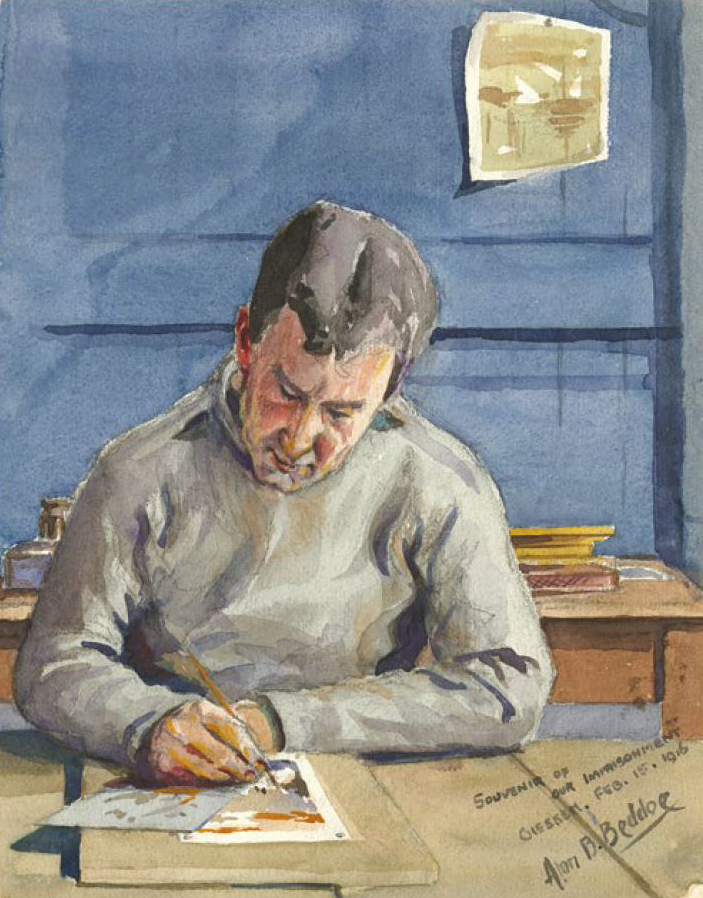
Alan Brookman Beddoe, O.C., O.B.E.
Private A. Nantel
Beaverbrook Collection of War Art
Canadian War Museum
CWM 19710261-0503
Royal Commission on Illegal Warfare Claims: The Reparations Commission, 1921–1933
For information specific to Canadian POWs, reference should be made to the McDougall Commission. In 1929, Justice Errol M. McDougall was appointed to investigate claims by Canadians of illegal warfare practices. In the course of his inquiry, he examined claims of POW mistreatment, including interviews of some 340 former POWs.
McDougall published a number of relevant reports, including Reparations, 1930–1931: Report, Maltreatment of Prisoners of War (Ottawa: King’s Printer, 1932); Reparations, 1932: Further Report (Ottawa: King’s Printer, 1933), and Reparations, 1932–1933: Final Report (Ottawa: King’s Printer, 1934).
McDougall and his predecessors looked into a multitude of claims for losses due to enemy action during the war. Claims were heard by successive commissioners on losses arising from the sinking of the Lusitania in May 1915, the destruction of merchant shipping and fishing vessels, civilian internment, and even claims for damage and injuries suffered by Canadians in air raids in Britain. In 1931, McDougall decided to investigate claims of alleged maltreatment of POWs by their German captors, and invited former POWs to submit claims for compensation. Some 862 individuals filed claims: 108 were withdrawn before consideration, and 553 were disallowed for various reasons, leaving 201 former POWs who were awarded financial compensation for their mistreatment during incarceration. It is not known if compensation was ever paid, given that the funds were supposed to come from the German government.
In his third report, Reparations, 1930–1931: Report, Maltreatment of Prisoners of War (Ottawa: King’s Printer, 1932), McDougall summarized more than 300 cases, including those disallowed. Each case study consists of a brief biographical sketch of the former POW, including name, unit, service number, enlistment details, marital status, pre-war and post- war occupational history, general medical condition, and details of his experiences as a POW (see especially pp. 23–326). The Report also includes an alphabetical index (pp. 327–332). In 1933, McDougall issued Reparations, 1932: Further Report (Ottawa: King’s Printer, 1933), in which he summarized an additional 243 disallowed claims (pp. 31–180), along with 38 claims that were allowed (pp. 181–214). This report also has an alphabetical index (pp. 215–217).
McDougall’s accounts of POWs and their experiences are extraordinary and, although not great in number, should not be overlooked when researching a member of the CEF who was a prisoner of war. The original records of the Royal Commission on Illegal Warfare Claims have not survived, but McDougall’s reports are available online as the Commission on Reparations at Library and Archives Canada (LAC).
Limits of documentation
Wartime records were created and kept for specific purposes, with contemporary ideas of importance. For example, ethnic origin was not recorded and a hometown might only be inferred through the address of next of kin, who may only be identified as Mrs. [husband’s name]. The language of administrative documentation was almost always English, regardless of the preferred language of the service person. In addition, some underage and overage soldiers gave a second name, while some names were misspelled in the administrative process.
Second World War, 1939–1945
Two major collections of information held by The National Archives of England and Wales contain information relating to Canadian POWs. These have been digitized and are available on ancestry.ca, as noted below.
Directorate of Military Intelligence: Liberated Prisoner of War Interrogation Questionnaires, 1945–1946 (WO 344) listed online by ancestry.ca as the UK and Allied Countries, World War II Liberated Prisoner of War Questionnaires, 1945–1949. The Questionnaires contain considerable personal information for a POW, including name, rank, service number and unit (regiment, squadron, ship, etc.), date of birth, place and date of enlistment, profession, home address, capture date, and where held. This database includes information on Canadian POWs.
The following databases are also available on ancestry.ca:
1. UK, British Prisoners of War, 1939–1945
Based on information originally produced by the Naval and Military Press, this database is an index only and does not include any original documentation. More than 2,000 Royal Canadian Air Force POWs are identified by name, rank, service number, POW number, camp, and location.
2. UK, World War II Allied Prisoners of War, 1939–1945
This draws upon information from several classes of records at The National Archives of England and Wales, including: AIR 40: Rolls of POWs 1939–1945; WO 392: POW lists 1943–1945; WO 361: Casualties and Missing Personnel 1939–1945; and WO 345: Japanese Index Cards of Allied POWs 1942–1947.
Sources vary, and results may be a list of names with some identifying information, or actual records as in the case of the Japanese index cards.
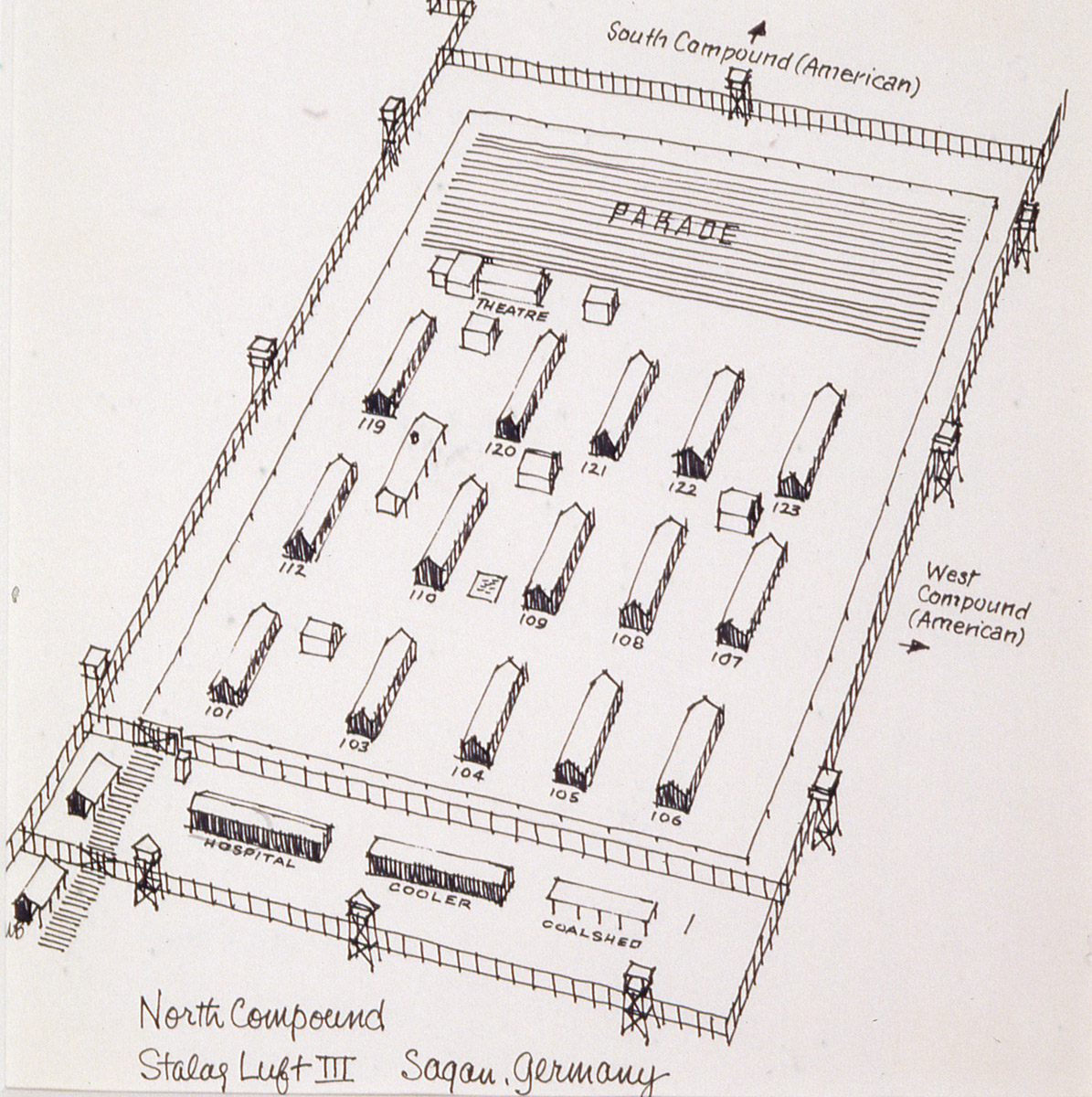
Drawing of North Compound Stalag Luft III, Sagan, Germany by Robert Marshall Buckham
Beaverbrook Collection of War Art
Canadian War Museum
CWM 19910176-004
Researchers should consult the website of The National Archives of England and Wales for the detailed guide: British and Commonwealth Prisoners of the Second World War and the Korean War.
For POWs captured at Hong Kong and held by the Japanese, the Hong Kong Veterans Commemorative Association (hkvca.ca) includes detailed reports on each and every member of what was known as “C” Force — including photographs, personal information, and camps where individuals were held and when. The website features diaries, letters, newspaper clippings, and additional reference material on all members of “C” Force, not only those who were POWs.
The service files of Canadians held as POWs may also be helpful. These records are held by LAC, and requests should be made using the Access to Information and Privacy Act, as outlined on the LAC website: Access to Information and Privacy (ATIP). To research those who died in captivity, or who perished prior to the end of 1947, please see the Canadian War Museum research guide: Canada’s War Dead and Missing at warmuseum.ca/mhrc.
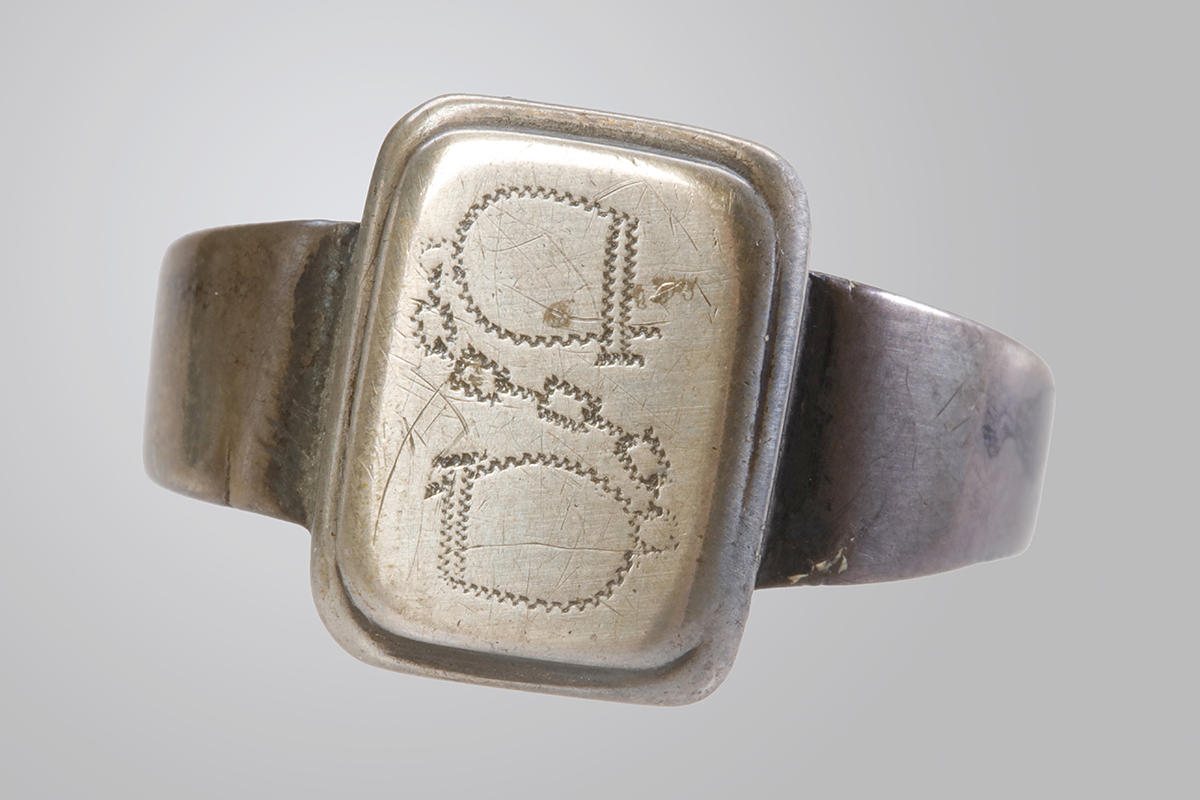
POW ring of Private Jack Powerful Griss, Stalag VIIIB, engraved with the shackles used on Canadian prisoners taken at Dieppe
Canadian War Museum
CWM 19740246-006
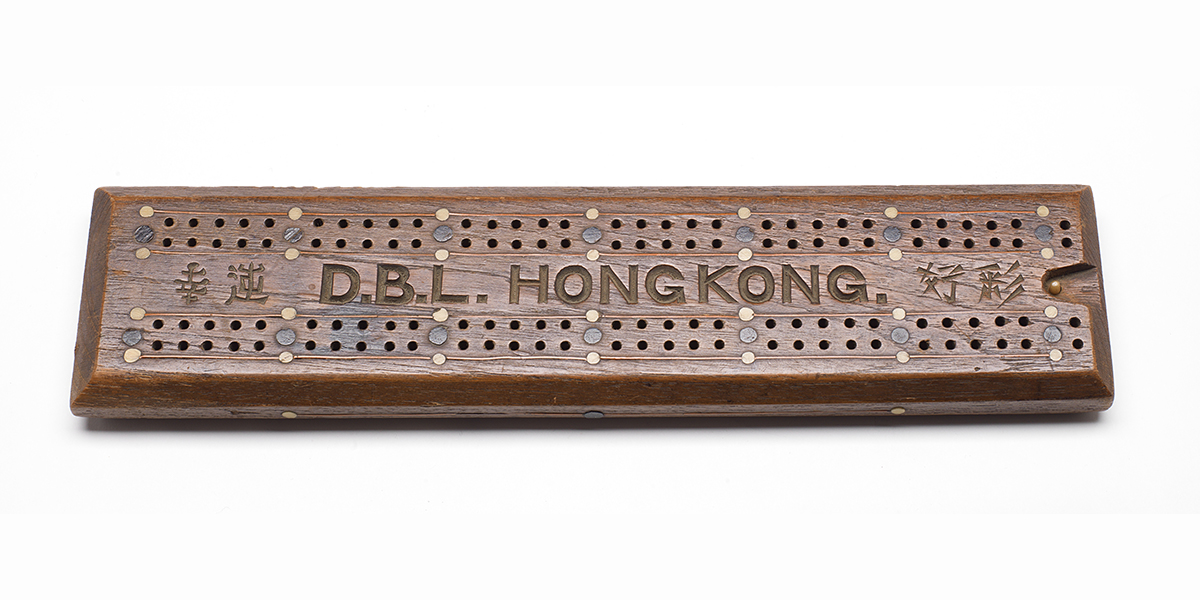
Carved wooden cribbage board of Second World War Hong Kong prisoner of war Lieutenant Donald B. Languedoc
Canadian War Museum
CWM 20170454-005
Enemy Prisoners of War in Canada
Canada agreed to receive both German and Italian prisoners of war and, by the end of the conflict, about 37,000 enemy soldiers, airmen and sailors, including merchant mariners, had been incarcerated at one of 30 camps across Canada.
A majority of POWs were employed at some point — often on farms at harvest time, or in lumber camps — and were paid for their labour. Records of the Directorate of Internment Operations, Department of National Defence (LAC, R112-133, microfilm reels T-7020 to T-76057) include pay records consisting of index cards with the full name and rank of the individual, his POW number, the camp or camps where he was held, and his remuneration.
These records are available on microfilm at LAC, and most of the reels have been digitized and can be viewed at Canadiana/Heritage by searching for the relevant microfilm reel number. Additional records relating to enemy prisoners held in Canada can only be consulted at LAC. These include International Committee of the Red Cross (ICRC) reports on specific camps (LAC: R112-133, volumes 11244–11273), and war diaries for each of the camps (LAC: R112-6744-3, volumes 15387–15414).
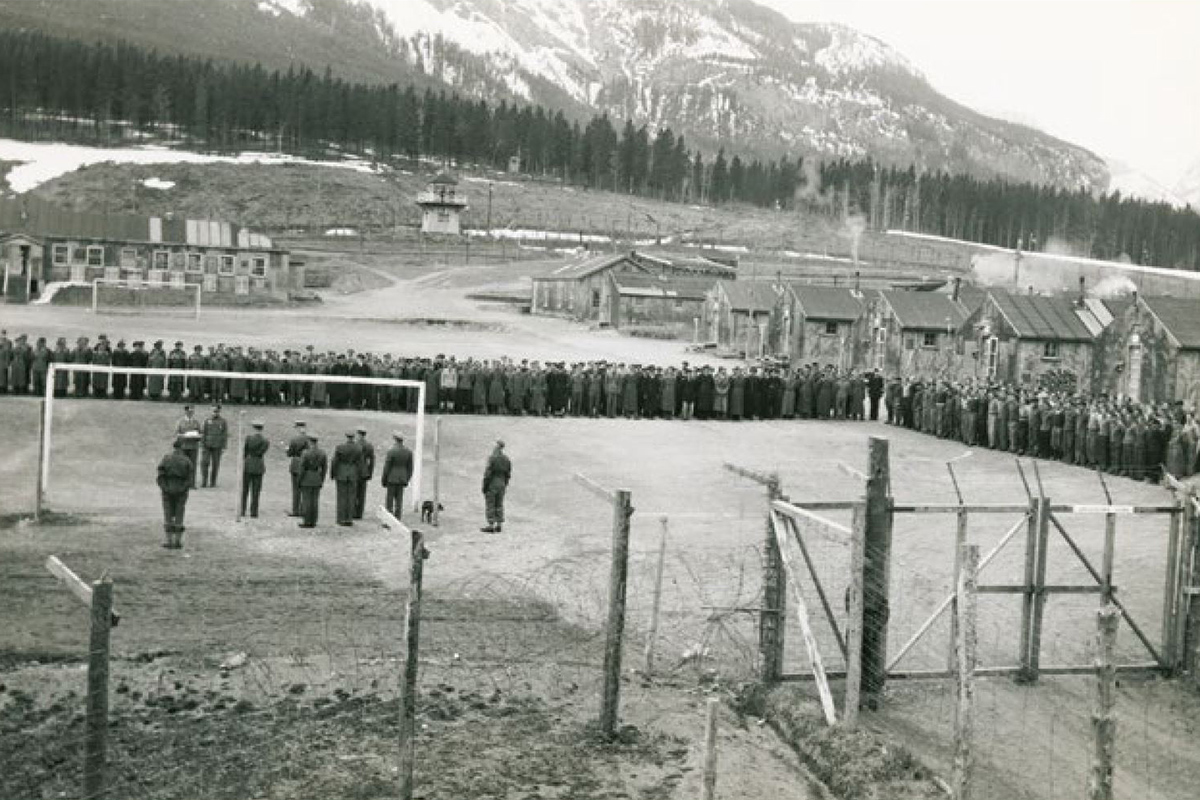
Kananaskis Internment Camp #130 located at Seebe, Alberta
George Metcalf Archival Collection
Canadian War Museum
CWM 19830444-070
Research at Library and Archives Canada
The archival resources stored at LAC are invaluable for research on any aspect of the First and Second World Wars. Researchers are encouraged to familiarize themselves with the LAC website, Collection Search, and its guides to research both world wars: “Personnel Records of the First World War” and “Second World War.”
Of special interest for Canadian prisoners of war are the war claims records of the Office of the Custodian of Enemy Property (reference: R1213-0-9, RG 117). Many of the files were created in the 1950s when Canadian POWs could claim compensation for maltreatment. These records contain information about circumstances of capture and imprisonment, and can be searched by name in Collection Search. They include applications from members of the Canadian military held prisoner by Germany or Italy, but not by Japan, as well as claims from other Canadians detained by enemy countries, including Japan, and for wartime losses due to enemy action.
The records are open but must be consulted on site.
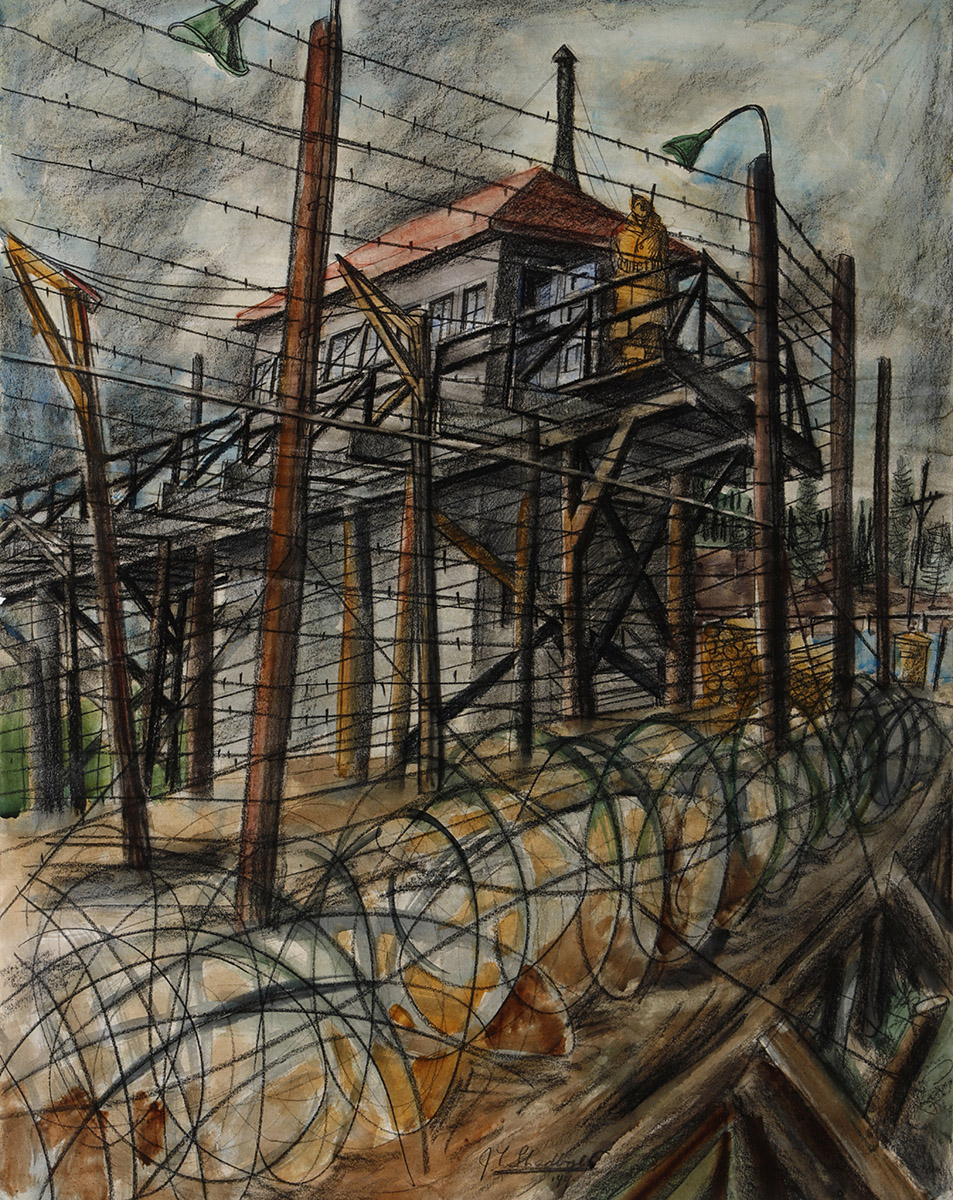
Jack Leonard Shadbolt
A Corner of the Compound
This painting depicts the German prisoner of war camp at Petawawa, Ontario.
Beaverbrook Collection of War Art
Canadian War Museum
CWM 19710261-5844
Canadian War Museum Resources
The Military History Research Centre (MHRC) at the Canadian War Museum houses the Hartland Molson Library Collection and the George Metcalf Archival Collection, both of which can be searched online through the MHRC catalogues. There are many resources related to the POW experience during the two wars, including memoirs, biographies, camp histories, and general histories. In addition, consulting a unit history, if one exists, can yield key information such as battles fought, group culture, photographs, names of others in the unit, etc.
The Museum’s library also offers items related to uniforms, equipment, training manuals, and books relating to many aspects of service. The Museum’s library and archives are predominantly personal in nature and can add an individual perspective to the official documentation held by LAC.
Suggested Reading
- Auger, Martin. Prisoners of the Home Front: German POWs and “Enemy Aliens” in Southern Quebec, 1940–1946 (UBC Press, 2005).
- Carter, David J. Behind Canadian Barbed Wire: Alien, Refugee and Prisoner of War Camps in Canada, 1914–1946 (Eagle Butte Press, 1998).
- Greenfield, Nathan M. The Damned: The Canadians at the Battle of Hong Kong and the POW Experience, 1941–1945 (HarperCollins, 2010).
- Greenfield, Nathan M. The Reckoning: Canadian Prisoners of War in the Great War (HarperCollins, 2016).
- Morton, Desmond. Silent Battle: Canadian Prisoners of War in Germany, 1914–1919 (Lester Publishing, 1992).
- Vance, Jonathan F. Objects of Concern: Canadian Prisoners of War Through the Twentieth Century (UBC Press, 1994). Provides an excellent overview for both world wars.
- Wigney, Edward H. Guests of the Kaiser: Prisoners of War of the Canadian Expeditionary Force, 1915–1918 (CEF Books, 2008). A good place to begin research on individual POWs.
- Zimmerman, Ernest. The Little Third Reich on Lake Superior: A History of Canadian Internment Camp R (University of Alberta Press, 2015).
The above-noted books have extensive bibliographies of first-hand accounts, diaries, and memoirs of Canadian POWs in both wars, as well as those of enemy prisoners interned in Canada. These books are available through the extensive holdings of the Canadian War Museum’s MHRC, and at other libraries.
Key Vocabulary
Prisoner of War (POW): Member of a country’s recognized military forces, captured and imprisoned by an enemy power during wartime. POWs do not include civilians detained in internment camps during wartime — for example, persons of German and Austo-Hungarian descent interned during the First World War, or persons of Japanese descent held during the Second World War in Canadian internment camps.
Service or regimental number: This was intended to be a unique identifying number for military personnel. During the First World War, Canadian Expeditionary Force regimental numbers were allotted in blocks to different areas of the country, and then to individual units. Some numbers were used more than once, however. During the Second World War, the Royal Canadian Navy, Canadian Army, and Royal Canadian Air Force had their own distinct numbering systems.
Unit: An encompassing term that refers to any organized military group that an individual could be assigned or attached to, including a regiment, battalion, squadron, ship, hospital, etc.
Have a research question?
Check out our Frequently Asked Questions (FAQs) or contact us directly. MHRC staff can provide answers and help with your research.
With thanks to guest contributor Glenn Wright, former archivist at LAC.