
In 2001, Canada went to war in Afghanistan. Following the September 11, 2001 terrorist attacks against the United States, Canada joined a coalition to pursue al-Qaeda and unseat the Taliban. Canadians served across Afghanistan, from the rural battlefields of Kandahar to the bustling city of Kabul, until 2014 when Canada ended its presence there.
More than 40,000 Canadians served in Afghanistan. More than a thousand were wounded. A diplomat and 158 soldiers died.
The consequences of the war in Afghanistan continue to ripple through our politics, the military, and the lives of those who served. The Long War: Canada in Afghanistan tells their stories. We examine why Canada went to war in Afghanistan, what happened there, and the war’s complicated legacy.
1. The Fall and the Beginning
We begin at the end, when Kabul falls to the Taliban in August 2021. Canadian veterans and journalists watch in shock as Afghans cling to departing planes at Hamid Karzai International Airport, desperate to escape.
The war in Afghanistan began in 2001, in retribution for the September 11 attacks. Canada joins the US-led invasion of Afghanistan to pursue al-Qaeda and unseat the Taliban.
But Afghanistan has a way of defying expectations. And the purpose and goals of Canada’s involvement in the war in Afghanistan proves to be complicated.
Read more: “The fall and the beginning: Canada in Afghanistan”
2. Into Battle (2001–2002)
The first Canadian battle group arrives in Kandahar and begins operations in southern Afghanistan in early 2002. The initial invasion has routed the Taliban, but Osama bin Laden escapes into Pakistan. The coalition begins to secure their position and create democratic structures to replace the ousted Taliban government.
Canadian troops enter combat during Operation Anaconda. They execute a complex air assault at The Whale’s Back. Snipers provide key tactical support to U.S. forces. And a devastating American friendly-fire incident at Tarnak Farms kills four soldiers, Canada’s first casualties of the war.
The troops return home after their first tour of duty to a triumphant welcome. But the mission faces growing uncertainty about what lies ahead for Canada in Afghanistan.
Read more: “First combat and casualties: Canada in Afghanistan, 2001–2002”
3. Defence, Diplomacy, Development (2003–2006)
This episode includes accounts of grievous injury.
Canada’s forces relocate to Camp Julien in Kabul as NATO takes responsibility for the International Security Assistance Force. Here, Canadian troops train Afghan forces, patrol in and around Kabul, and build relationships with the local community.
Afghanistan successfully elects a president and parliament. Ongoing Taliban resistance, including mine strikes and Afghanistan’s first suicide bombing, challenge optimistic expectations of progress.
In 2005, Canada begins to redeploy to Kandahar Province, a large and geographically diverse area rife with insurgency. The assassination of diplomat Glyn Berry, IED attacks, and suicide bombings complicate Canada’s diplomatic and development efforts, forcing the military to focus on security and counterinsurgency.
Read more: “Combat and diplomacy: Canada in Afghanistan, 2003-2006”
4. Operation Medusa (2006)
This episode includes accounts of grievous injury.
The Taliban increases in strength and takes a more aggressive stance in the spring and summer of 2006. Hundreds of Taliban fighters prepare to directly challenge NATO forces near Kandahar City. Operation Medusa is launched to counter this new threat.
Operation Medusa is the largest battle Canadian forces fight in Afghanistan. Twelve soldiers die. Dozens more are injured.
Canadian maneuvers get off to a difficult start, with disagreement over an accelerated advance. Much of the early fighting centres on the White School, a key Taliban stronghold in Panjwaii. Canadian soldiers are killed and wounded in an unsuccessful attack on the site before it is taken.
Ultimately, Canada regroups and Operation Medusa succeeds, despite deaths by accident, suicide bombing, and friendly fire. The Taliban suffers a tactical setback on the battlefield. But now the character of the war is about to change. And in some ways, it becomes even more dangerous.
Read more: “The White School and Operation Medusa: Canada in Afghanistan, 2006“
5. Home Front (2006–2008)
In the wake of 9/11, the Canadian public is strongly behind the war in Afghanistan. But over time, support wanes. The ongoing costs of the war, political disagreements over its purpose, and a series of scandals erode public trust and raise questions about the mission and its direction.
In 2006, widespread media coverage of the death of Captain Nichola Goddard draws attention to the human cost of the war. At this point, several years into the war, the public is divided. Many share their patriotism and grief in vigils and yellow ribbon campaigns urging people to “support the troops.” However, anti-war voices and protests grow louder.
A scandal erupts the next year over Canadian forces delivering prisoners to Afghan custody — and reportedly, to torture. In early 2008, former Liberal MP John Manley delivers a report on the conduct and outcomes of the war. It is critical of many systemic problems but ultimately supports a continued mission.
And so, despite an uncertain public and a divided Parliament, Canada remains committed to the war in Afghanistan.
Read more: “Politics and public opinion: Canada in Afghanistan, 2006–2008“
6. The Grind (2007–2010)
This episode includes accounts of grievous injury.
Defeated in Operation Medusa, the Taliban shifts to insurgency tactics. Asymmetric warfare is the order of the day as Canada leads the Kandahar Provincial Reconstruction Team.
Improvised explosive devices (IEDs) are a constant danger and insurgents mingle with the locals. Troops are on constant alert for invisible threats. When the worst happens, combat casualties arrive at the Role 3 combat hospital, where medical teams stabilize them for evacuation out of the country.
The psychological toll of deployment mounts as the war continues. But Canada’s military engagement in Kandahar will soon be coming to an end.
Read more: “Counterinsurgency in Kandahar: Canada in Afghanistan, 2007-2010“
Podcast trailer
By focusing on the voices of the people who were there, The Long War combines powerful firsthand storytelling with thoughtful reflection on a defining chapter in Canadian military history.
Credits
The Long War: Canada in Afghanistan is a podcast by the Canadian War Museum.
- Narrator: Anna Maria Tremonti
- Historian: Andrew Burtch
- Producers: Lisa Gabriele and Neil Morrison
- Associate Producer: Hailey Choi
- Mixing: Cameron McIver
- Executive Producers: Jenny Ellison and Steve McCullough
- Text editors: Shannon Moore and Pascal Scallon-Chouinard
Many voices heard in The Long War come from the Canadian War Museum’s oral history project, In Their Own Voices: Stories from Canadian Veterans and Their Loved Ones. Both of these projects have been generously funded by donors including the A. Britton Smith Family; the Azrieli Foundation; Arthur B.C. Drache, C.M., K.C., and Judy Young Drache; The Royal Canadian Legion; The Legion National Foundation; Friends of the Canadian War Museum; the Crabtree Foundation; Robert Stollery, in honour of his service in the Second World War; Colonel (Ret’d) Stanley A. Milner, O.C., A.O.E., M.S.M., C.D., LL.D.; and individuals from across Canada.
The podcast cover image shows private Michael Kubis of The Royal Canadian Regiment, standing in a cloud of dust moments after the detonation of an improvised explosive device (IED) in Panjwaii District, Kandahar, in 2010.
Photo: Louie Palu.
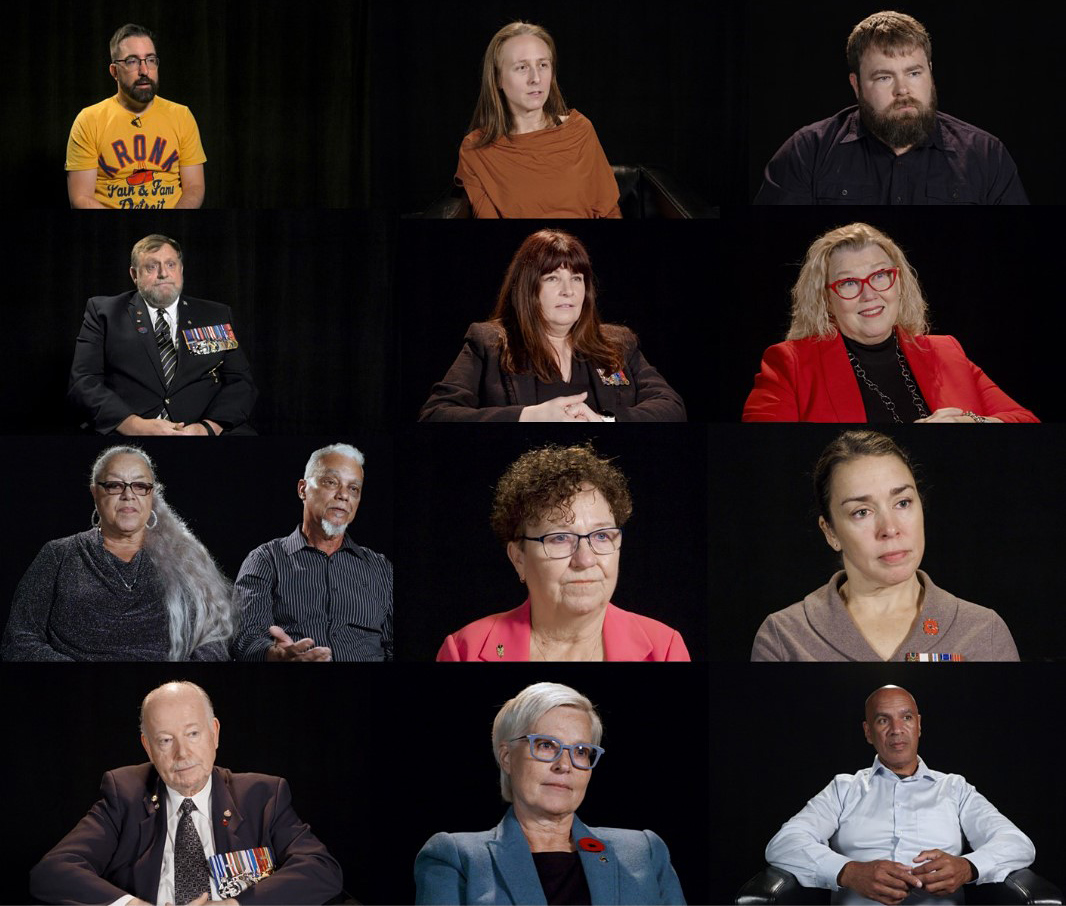
In Their Own Voices
In Their Own Voices is an oral history project about Canadian veterans’ postwar and post-service lives from the Second World War to the present day. It consists of more than 200 interviews with veterans and their loved ones.
Explore their stories