The fall and the beginning: Canada in Afghanistan
Twenty-five years ago, Canada went to war in Afghanistan.
Following the September 11, 2001, terrorist attacks against the United States, Canada was an early participant in the US-led “war on terror.”
In October 2001, the U.S. initiated hostilities against Afghanistan’s Taliban government. The Taliban had supported the al-Qaeda terrorist organization responsible for the attacks. In short order, the Taliban and al-Qaeda were routed. A new government was installed with promises of international support.
The fall of Kabul, 2021
Nearly 20 years later, the Americans and their allies departed, leaving the Afghan government to face a resurgent Taliban. Kabul fell to the Taliban in August 2021, after they swept swiftly and almost unopposed across the country.
Canadian veterans and journalists watched in shock as Afghans clung to the landing gear of planes taking off at Hamid Karzai International Airport, desperate to escape.
Captain Dennis LeBlanc was deployed twice to Afghanistan. He recalls watching the chaos and worrying about the fate of Afghanistan: “I gotta admit, it was tough, because we had made some friendships with interpreters, various soldiers that were over there. You know, I consider them comrades as well. And I have no idea what happened to them.”
To understand the ultimate failure of the U.S. and NATO efforts to secure Afghanistan, we return to the terrorist attacks of September 11, 2001. These watershed events initiated the so-called Global War on Terror and led to Canada’s involvement in Afghanistan.
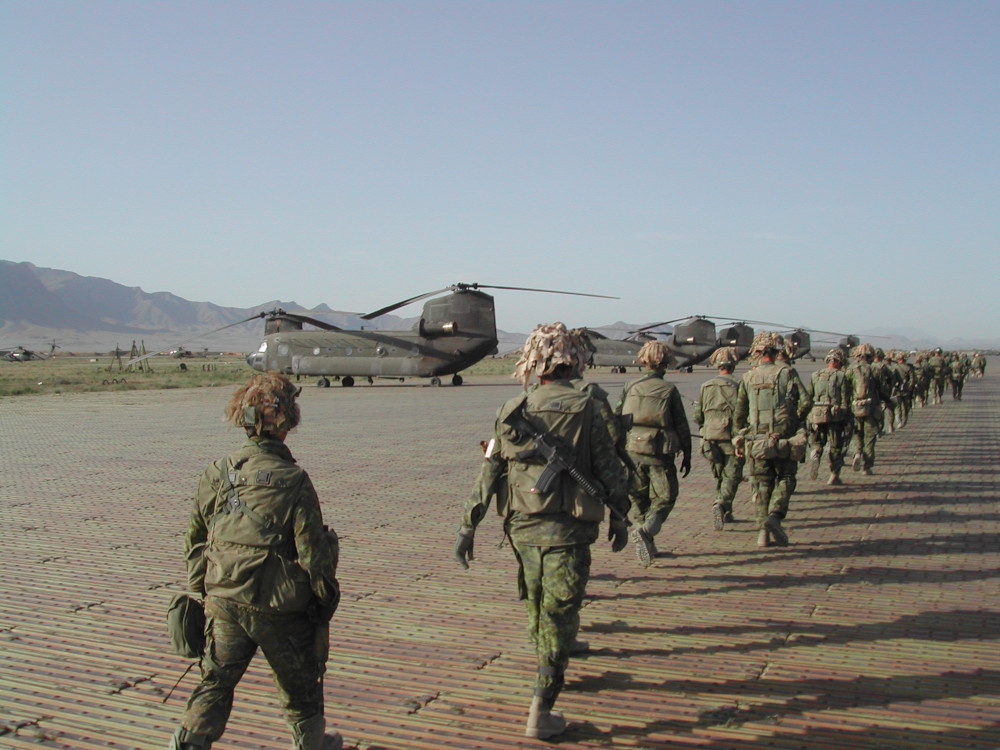
Canadian soldiers head for CH-47 Chinook helicopters in May 2002. They are on their way to Tora Bora to pursue Taliban and al-Qaeda forces.
George Metcalf Archival Collection, Canadian War Museum, CWM 20080028-009_DSCN0001. © Stephen Thorne (2002), The Canadian Press.
September 11, 2001
Nineteen terrorists hijacked airliners and used them to destroy both towers of the World Trade Center in New York City and damage the Pentagon in Washington. A fourth plane crashed in rural Pennsylvania after the passengers got word of the first attacks and fought back. The hijackers killed 2,977 people, including 24 Canadians.
Canada was quick to offer support to our southern neighbour. Prime Minister Jean Chrétien stated. “Together with our allies, we will defy and defeat the threat that terrorism poses to all civilized nations. Mr. Ambassador, we will be with the United States every step of the way — as friends, as neighbours, as family.”
North American airspace closed to commercial air traffic. This stranded thousands of Americans in Halifax, Nova Scotia, and Gander, Newfoundland and Labrador. They received support and temporary housing from local communities.
In the immediate aftermath of the attacks, NATO invoked Article 5 of the North Atlantic Treaty. This provision is dedicated to mutual defence. An attack on any member is considered an attack on all, and they are committed to respond.
![Aerial view of a large damaged and burned building with several construction vehicles working in the foreground.]](https://www.warmuseum.ca/wp-content/uploads/2026/09/DF-SD-04-12734-edit.jpeg)
Emergency crews respond to damage at the Pentagon caused by the 9/11 terrorist attacks.
Photo: TSGT Cedric H. Rudisill, USAF, https://catalog.archives.gov/id/6631948
![A huge cloud of smoke billowing up behind a city skyline with a body of water in the foreground.]](https://www.warmuseum.ca/wp-content/uploads/2026/09/159455100_89a4057c18_o-edit.jpg)
Downtown Manhattan in the immediate aftermath of the fall of the World Trade Center towers.
Photo: Wally Gobetz / Flickr, CC BY-NC-ND 2.0, https://www.flickr.com/photos/wallyg/159455100
Intelligence quickly determined that the al-Qaeda terrorist network was responsible. Al-Qaeda is a radical Islamist terror organization founded by Osama bin Laden. The organization had previously undertaken deadly attacks against U.S. embassies in Kenya and Tanzania and the USS Cole in Yemen. In the mid-1990s, the Taliban gave shelter to al-Qaeda after they departed Sudan.
U.S. President George W. Bush announced a global “war on terror” shortly after September 11. Its aim was to target global terrorist groups such as al-Qaeda and the national governments that supported them. President Bush set out its international implications in stark terms: “Every nation, in every region, now has a decision to make. Either you are with us, or you are with the terrorists. “
The American government made a series of demands. The Taliban were to hand over al-Qaeda’s leadership, close their training camps, and release their foreign prisoners. They refused. And so, America began an air and ground campaign against the Taliban. Initially, this consisted of supporting the Northern Alliance, an anti-Taliban coalition based in north Afghanistan.
Afghanistan, the Taliban, and al-Qaeda
Afghanistan has a long history of resisting foreign aggression. The British tried and failed to conquer it in the 19th century. The Soviet Union fought there for a decade. The war killed hundreds of thousands of people, displaced millions more, and ended with their retreat in 1989.
The U.S. government assisted the USSR’s many opponents in Afghanistan. American money and weapons helped a variety of Afghan factions. This included the “mujahideen,” among whom were various Islamist militant groups.
![A light-skinned man in a brown bomber jacket stands with five medium-dark-skinned men wearing green jackets, one carrying a large weapon across his shoulders.]](https://www.warmuseum.ca/wp-content/uploads/2026/09/metapth255276_xl_0064_charlie-wilson-mujahideen-edit.jpg)
U.S. Congressman Charles Wilson poses with mujahideen in Afghanistan, 1987.
Photo: University of North Texas Libraries, The Portal to Texas History, https://texashistory.unt.edu/ark:/67531/metapth255276/
After the USSR departed, Afghanistan descended into chaos. The Soviet-backed government and the many resistance factions fought for control of Kabul. The Taliban ultimately arose victorious. It took hold first in Kandahar and then successfully fought for and held Kabul in 1996.
The Taliban group arose in protest against local warlords and corruption. They fused conservative Islamic fundamentalism with Pashtun ethnic nationalism. (Pashtuns are the largest cultural group in Afghanistan, which is home to a great diversity of languages and ethnicities.) Once in power, they became famous for imposing restrictions on women’s freedoms, religious intolerance (made famous by their destruction of ancient Buddhist statues in Bamiyan), and widespread human rights abuses.
Early victory
The initial U.S. effort involved working with anti-Taliban factions, notably the Northern Alliance. The CIA and U.S. Special Forces had been operating in Afghanistan since a couple of weeks after 9/11, laying the groundwork for invasion.
Overt military operations began on October 7, 2001, with dozens of airstrikes across the country. Several days of bomb, missile and drone attacks followed. Troops began to arrive in greater numbers as of October 19.
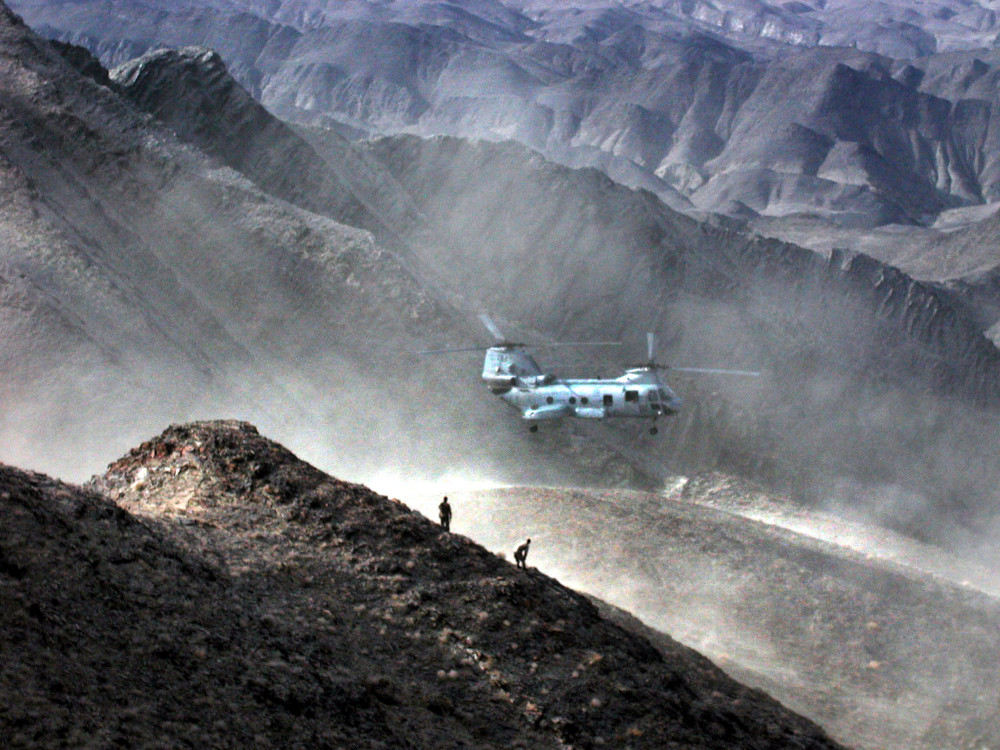
A helicopter delivers U.S. Marines to an undisclosed location in Afghanistan in January 2002.
Photo: PHC Johnny Bivera, USN / https://catalog.archives.gov/id/6640985
Canadian warships and aircraft had deployed to support the operation in October and November. The Canadian Armed Forces’ name for the mission was Operation APOLLO. Canadian special forces were reportedly on the ground in Afghanistan beginning in December 2001.
The Taliban government in Kabul fell to the invading forces in just three weeks. A wider military victory, including in the Taliban’s traditional home territory of Kandahar, took only two months.
Historian and journalist Michael Petrou was there, covering the war for the Ottawa Citizen. He says, “I certainly didn’t expect the Taliban lines to collapse as quickly as they did in the fall of 2001 and for Kabul to fall.”
![A smiling person with medium skin, a wool hat, and loose tan clothes crouches on a low mountain ridge, facing the camera, with a river valley in the background.]](https://www.warmuseum.ca/wp-content/uploads/2026/09/98a60f76-b3ba-46ff-b76c-be2f8cb2f00d-crop.jpeg)
Michael Petrou in northern Afghanistan in 2001.
Photo: Michael Petrou, supplied
The end of the beginning
In December 2001, a group of Afghan and world leaders gathered in Bonn, Germany, to negotiate a political path forward for Afghanistan.
Hamid Karzai, leader of the Pashtun opposition to the Taliban, was the consensus choice. He became chairman of the new interim national administration. Next steps were to draft a constitution and prepare for elections.
The Bonn Agreement also laid the foundation for the UN-authorized (and later NATO-led) International Security Assistance Force. This multinational military effort would remain in Afghanistan until 2014.
In a remarkably short time, the Taliban had been unseated, al-Qaeda was scattered, and a democratic framework was coming into being.
For Canada, the celebrations in Bonn served as a preface for its soldiers’ involvement in Afghanistan. A battlegroup led by the Princess Patricia’s Canadian Light Infantry began preparing. They would deploy to Kandahar, the Taliban’s original seat of power, in early 2002.
Canada would go on to fight in Afghanistan for 13 years. It became our longest war.
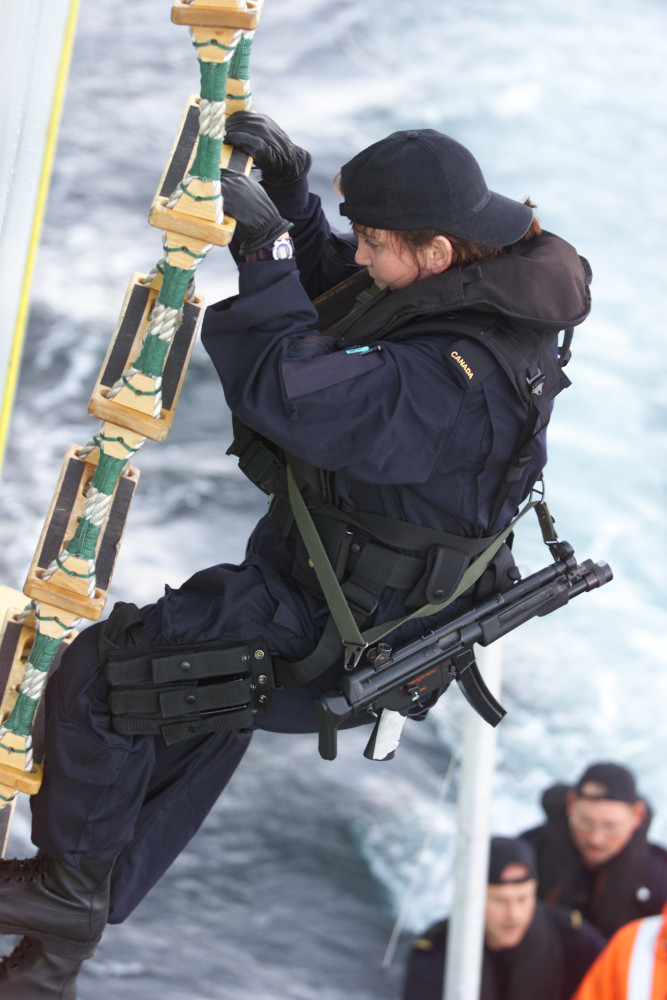
Corporal Pamela Brace climbs aboard HMCS Preserver during boarding and landing exercises on the way to the Arabian Sea, October 2001. The Canadian navy’s role included escorting ships and intercepting and boarding suspect vessels.
Photo: MCpl. Brian Walsh, J5PA Combat Camera © All rights reserved. ISD01-9567a reproduced with the permission of DND/CAF (2026)
The Canadian War Museum’s podcast The Long War: Canada in Afghanistan tells the story of Canada’s involvement and what the war came to mean to those who served.
Subscribe to The Long War wherever you get your podcasts.
Steve McCullough
Dr. Steve McCullough is the Digital Content Strategist at the Canadian Museum of History and the Canadian War Museum. His work in digital storytelling involves compassionate and evidence-based efforts to address history, meaning and identity in our fragmented and polarizing, but also vibrant and interconnected, online environment.
Andrew Burtch
Dr. Andrew Burtch has been the Historian, Post-1945 at the Canadian War Museum since 2006. He is the curator of Gallery 4: From the Cold War to the Present, which examines Canada’s response to conflicts from the beginning of the Cold War to the present day. His main areas of research include Cold War history, nuclear civil defence, United Nations peacekeeping missions, the Korean War, war and memory, and oral history.
Read full bio of Andrew Burtch